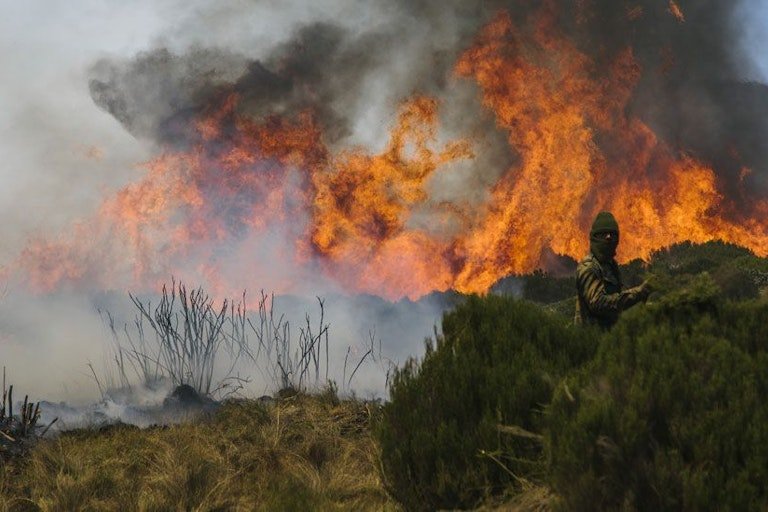
Mount Kenya has been burning for seven days, and still is as we speak. The fire, which began on September 1, 2026, has spread across sections of the mountain’s high altitude vegetation, with shifting winds repeatedly reigniting areas that had already been brought under control.
This is not simply a story about a forest fire on Africa’s second tallest mountain. Mount Kenya is one of the country’s critical water towers, supporting ecosystems, rivers, wildlife, agriculture and communities far beyond the mountain itself.
The saddest part about this whole occurence is how the consequences of losing vegetation in such a sensitive ecosystem could continue long after the flames disappear.
Currently, firefighting teams and community volunteers are working alongside conservation organisations and government agencies to contain it.
According to the Mount Kenya Trust, as many as 17 separate fire points were visible at one time during the first days of the blaze.
The fire has affected areas including the eastern flank of Kibiaranyeki, Rutundu, Lake Alice and Lake Ellis, with strong winds pushing flames south and west. Teams have repeatedly managed to put out fires only for new ones to spread elsewhere, with the terrain itself presenting a major challenge.
Mount Kenya’s high altitude landscape is difficult to access, meaning that getting personnel and equipment to some affected areas is not straightforward. Strong winds have also made containment considerably harder and is why a fire can continue for days even when large firefighting efforts are already underway.
The response has brought together the Kenya Wildlife Service, Kenya Forest Service, Mount Kenya Trust, community forest associations and other conservation partners, with aerial and ground support also being mobilised.
But seven days into the fire, the mountain is still burning(!)
The Aberdare fire shows why this should concern Kenya
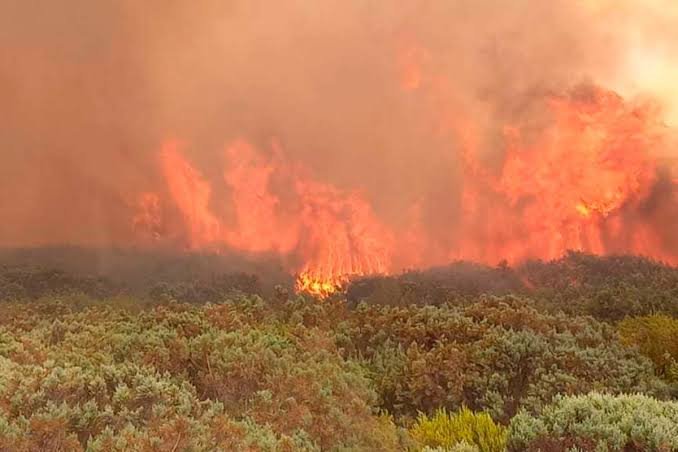
The Mount Kenya fire comes barely days after another major fire affected the Aberdare ecosystem.
The Aberdare fire began around Kinangop Peak on August 28 and destroyed more than 200 acres of vegetation before it was brought under control.
KWS deployed 62 personnel alongside community volunteers, with support from KFS, Rhino Ark, the Aberdare Joint Surveillance Unit and local authorities. Strong winds and dry vegetation made the operation difficult.
The Aberdare fire was particularly concerning because the blaze moved towards catchment areas supplying water to Lake Ol Bolossat and Ol Kalou.
Their is an important connection that might escape most people’s attention – the Aberdares and Mount Kenya (both scenic landscapes and tourist destinations) are part of the natural infrastructure that helps Kenya collect, store and regulate water.
KWS describes Mount Kenya and the Aberdare Range among the country’s major water towers, whose ecosystems support rivers supplying water for domestic use, agriculture, industry and hydropower generation.
When these ecosystems are damaged, therefore, the consequences can extend well beyond the boundaries of a national park or forest.
Why does a fire on Mount Kenya threaten Kenya’s water?
The relationship between forests and water is easy to overlook because it is not immediate.
A forest does not simply produce water. Instead, healthy vegetation helps regulate how rainfall interacts with the ground. Vegetation and soils allow water to infiltrate into the ground, slow down runoff and reduce erosion. This helps maintain the health of catchments and supports the gradual release of water into rivers and other waterways.
When vegetation is severely burned, those processes can be disrupted.
The immediate consequences can include exposed soil, increased erosion and greater runoff when rain eventually arrives. Over time, repeated or extensive degradation can reduce the ability of an ecosystem to regulate water effectively.
While that doesn’t mean a Mount Kenya fire will suddenly cause taps in Nairobi or elsewhere to run dry, it is still a potential risk.
Damage to a water tower can weaken the natural systems that help provide reliable water over time, and is why protecting the mountain should be a priority to every conscious kenyan, even those who may never set foot on the mountain.
It is worth noting also, that the current fires are not happening in isolation. In 2025, the Kenya Forest Service reported a sharp increase in forest fires during the first two months of the year.
By late February, KFS had recorded 180 forest fire incidents, which had affected approximately 1,358 hectares of vegetation in gazetted forests.
The affected areas included the Mau, North Rift, Coast, Central Highlands – including Mount Kenya and the Aberdares – and Eastern conservancies.
KFS attributed the high fire danger at the time to dry conditions, high temperatures, low humidity and strong winds, while also warning about rapidly drying vegetation and accumulated combustible material.
Mount Kenya Trust also notes that fires have become an increasingly serious threat to the mountain’s ecosystem, citing prolonged drought, climate change and human activity around forest boundaries among factors contributing to the risk.
At which point, we can’t help but ask how prepared Kenya is to deal with increasingly difficult fires in its most important ecosystems.
Obviously, putting out the fire is only the first step, and the ecological recovery could take considerably longer.
Some vegetation may regenerate naturally, while severely damaged areas could require active restoration. Wildlife habitats may also be affected while burned and exposed soils can become vulnerable to erosion.
For now, firefighters and volunteers are still working to bring the Mount Kenya blaze under control.
The immediate story is about stopping the fire – understandably – but the bigger story is what happens to the mountain and the systems that depend on it after the fire is finally out.