Germany had surrendered, but the Allies could not agree on what should happen next. What began as a plan to govern a defeated country together gradually became one of the defining divisions of the Cold War.
When the Second World War ended in Europe in May 1945, Germany became alot of things – a defeated country waiting for a new government, a country whose political system had collapsed and whose cities lay in ruins, but most importantly, a country whose future was now in the hands of the very powers it had spent years fighting.
You would think that the allies (Soviet Union, United States, Britain and France) having defeated Nazi Germany together, would automatically become friends. Hadn’t they, after all, defeated a common enemy? Far from it. They had different political systems, different ideas about Europe’s future and increasingly, different understandings of what a safe postwar Germany should look like.
But they had to – for the moment anyway – work together. Germany needed to be disarmed and rebuilt. The Nazi state had to be dismantled, its leaders held accountable and its institutions reshaped. Not to forget also the millions of people who needed basic needs and somewhere to start afresh.
But now, how were they to do all this without allowing Germany to become a military threat again? And even more importantly, who would shape the future of Europe?
The arguments had started before Germany surrendered
The Allies did not wait until the war was over to discuss Germany’s future. In February 1945, while fighting was still taking place in Europe, US President Franklin D. Roosevelt, British Prime Minister Winston Churchill and Soviet leader Joseph Stalin met at Yalta, in Crimea.
The conference was meant to coordinate the final stages of the war and begin planning for peace. Germany would be disarmed and demilitarised, the Nazi Party would be eliminated and the country would be occupied by the victorious powers. The leaders also discussed reparations, the future of Poland and the political arrangements that would follow the defeat of Nazi Germany.
It however, wasn’t all rosy because each leader wanted something different from the settlement.
Here were the circumstances; the Soviet Union had suffered catastrophic losses due to German forces invading their territory in 1941, a period in which they left entire cities and farmlands destroyed. And we haven’t even started on the millions of people they left dead in their wake. Stalin wanted Germany weakened sufficiently to prevent another invasion from the west plus compensation for the enormous destruction caused by the war. Amongst the allies, the Soviet Union had paid a staggering price for victory. And Stalin was determined that Germany should contribute to its reconstruction.
The Americans and British, who also wanted Germany disarmed and prevented from starting another war, were becoming increasingly concerned about the spread of Soviet influence across Eastern Europe. They wanted a postwar settlement that would allow democratic political institutions to develop and, eventually, a functioning European economy.
These were arguments about power, security, ideology and the kind of Europe that would emerge after the war – and no drawing of occupation boundaries could wish them away.
Yalta, unable to settle everything, established a broad framework and left many of the difficult practical questions for a later meeting.
By the time the leaders met again in July 1945, the political landscape had already changed. A lot had happened – literally. Germany had surrendered on 8 May, Roosevelt had died in April and had been succeeded by Harry S. Truman. And Truman, he was far less familiar with Stalin than his predecessor. Meanwhike in Britain, Churchill attended the opening of the conference but was replaced by Clement Attlee after the Labour Party won the general election.
Everyone was experiencing something.
The meeting took place in Potsdam, outside Berlin, from 17 July to 2 August 1945. It was here that the Allies tried to turn their broad wartime agreements into an actual plan for governing Germany.
Four powers, four occupation zones
The decision to divide Germany into occupation zones had been discussed before Potsdam. The original arrangements were agreed by the United States, Britain and the Soviet Union in 1944. France was subsequently included as an occupying power and the boundaries were finalised in 1945.
Germany, for occupation purposes, would be divided into four zones. The Soviet Union would administer the eastern zone, Britain the north-west, the United States the south and south-west, and France the south-western area carved out of the American and British zones.
Each power would exercise authority in its own zone. Its military commander would oversee the administration, security and implementation of Allied policy.
On paper, this was a practical arrangement, right? Especially because the Allies could not realistically administer every part of a defeated Germany from one office with millions of soldiers, prisoners, displaced people and civilians to account for.
But the division was not supposed to mean that Germany would become four separate countries.
The plan was to govern the country through a joint Allied system. The four powers would coordinate decisions affecting Germany as a whole through the Allied Control Council, established in June 1945. It was made up of the four military commanders-in-chief, and major decisions required agreement among them.
In other words, the Allies were dividing the administration of Germany while still claiming to preserve it as one country(!)
The division into four zones was initially an arrangement for occupation, not an agreed plan to create two permanent German states. The assumption was that the powers would cooperate, carry out their responsibilities and eventually reach a settlement for Germany’s future.
But would the parties involved cooperate? That was the million dollar question.
Another question we need to look at is, Why was Berlin divided too?
There was one particularly unusual feature of the arrangement. Berlin, the German capital, was also divided into four occupation sectors, despite the fact that Berlin sat deep inside the territory assigned to the Soviet Union.
Why give the Western Allies a presence in a city surrounded by Soviet controlled territory?
Well, because Berlin had been the capital of Nazi Germany and the centre of the regime that the Allies had defeated. The city, considered too important to be placed under the authority of one occupying power alone, had to be shared amongst the four.
It was a strange arrangement, and one that would become extremely important.
A city divided between four foreign powers, with three of those powers having to maintain access through territory controlled by the fourth might have seemed manageable in 1945, when the wartime alliance was still intact. A few years later, it would become a major source of confrontation.
Berlin became a symbol of the competing visions for Germany and Europe, making it one of the most sensitive places in the emerging Cold War.
What did the Allies actually want Germany to become?
At Potsdam, the Allies agreed on a set of principles that were meant to guide the occupation. Germany was to be demilitarised, denazified, democratised and decentralised. Its military capacity would be dismantled, Nazi organisations abolished, leading war criminals prosecuted and public institutions cleared of Nazi influence.
The country was also to be treated as a single economic unit. This was important because Germany’s economy had been deeply interconnected before the war. Its mines, factories, transport networks, banks and agricultural regions depended on one another. Dividing the country into separate economic systems risked making recovery even harder.
But the agreement contained a contradiction that would become difficult to manage. Each occupying power was entitled to take reparations from its own zone. The Soviet Union, whose territory had suffered immense destruction, was also entitled to receive additional industrial equipment from the Western zones under an agreed arrangement. The intention was genuine – compensate the victorious countries while preventing Germany from rebuilding its military industrial capacity.
The Western powers, however, were increasingly worried that dismantling too much German industry would make the country dependent on foreign assistance and create economic instability across Europe. The Soviet Union on the other hand did not care. They had suffered great loss and were determined to secure the resources it believed Germany owed it.
There was also a fundamental political disagreement. The Soviet Union wanted a Germany that could not threaten it again and was increasingly committed to transforming its occupation zone along socialist lines. The Western powers wanted political pluralism and a market oriented recovery that would eventually make Germany part of a wider Western European economic system.
The language of the Potsdam Agreement still spoke of a united Germany. The policies being pursued in the different zones, however, were beginning to point in different directions.
We all know what happens when such politics play out. Germany’s ordinary people were caught in the middle. While the Allied leaders argued about Germany’s future, German citizens were barely holding on to the present.
Much of the country had been devastated by bombing and fighting. Homes, factories, railway lines, bridges, public buildings -basically everything you could think of had been destroyed. Berlin, particularly, had been hit the hardest. Hundreds of thousands of its apartments had been destroyed and the population fell sharply from its prewar level.
Food was scarce. Fuel was difficult to obtain. Transport systems were broken and many people had lost their homes or been separated from their families. In cities, residents searched through rubble for usable materials as black markets became part of everyday life simply because people were struggling to find basic goods.
The population was also being reshaped by enormous movements of people. Germans were fleeing or being expelled from territories that had been part of Germany before the war, particularly areas transferred to Polish and Soviet administration. Millions of refugees and expellees arrived in the occupation zones, placing even greater pressure on already limited housing, food and public services.
Simply, it was a humanitarian crisis of sorts.
The Potsdam settlement had accepted the transfer of German populations from several parts of Eastern Europe, with the agreement that these transfers should be carried out in an orderly and humane manner. In reality, the expulsions were often violent and deeply traumatic. Families lost homes, possessions and communities, while the receiving areas struggled to accommodate the arrivals.
And then ofcourse, the difficult task of having to deal with the legacy of Nazism.
The Allies began removing former Nazi officials from positions of influence, dissolving Nazi organisations and establishing processes to investigate individual responsibility. War crimes trials, including the Nuremberg trials, sought to hold senior Nazi leaders accountable. Schools, courts, newspapers and public institutions had to be rebuilt without simply restoring the structures of the previous regime.
But denazification was not as straightforward as you might think. Millions of Germans had been members of Nazi organisations or had worked within institutions that supported the regime. The occupying powers disagreed over how far responsibility should extend and how quickly Germany needed people with administrative and technical experience to get basic services running again.
For ordinary Germans, the end of the war did not mean an immediate return to normal life. They were living under foreign military occupation, facing shortages and uncertainty, while being asked to confront the crimes committed in the name of their country.
It is important to note too, that the experience was not identical across the four zones. Each occupying power had its own approach, priorities and political expectations.
The alliance begins to fall apart
It starts to get interesting, as I am sure you already predicted (if you’ve read this far).
By 1946, the differences between the Soviet Union and the Western powers were becoming harder to contain.
In the Soviet zone, land reforms, nationalisation and political restructuring were changing the economic and political landscape. The Communist Party, working through a political merger with the Social Democrats in the Soviet zone in 1946, consolidated its position. Opposition parties continued to exist, but political competition increasingly took place under conditions shaped by Soviet power.
In the Western zones, the Americans, British and French gradually moved towards closer economic and political cooperation. Their concern was no longer only how to prevent Germany from becoming dangerous again, but that a collapsed German economy would undermine the recovery of the rest of Europe.
The Western zones were merged economically in stages. The American and British zones formed what became known as Bizonia in 1947, with the French zone joining the arrangement in 1948; a major step towards a separate West German economic system.
The United States also introduced the European Recovery Program, better known as the Marshall Plan, in 1948. It offered American economic assistance to help rebuild European economies. The Soviet Union rejected participation and prevented the governments of Eastern Europe under its influence from joining.
Germany’s future was increasingly tied to this wider division of Europe.
The Allied Control Council, which was supposed to coordinate policy for the whole country, became less effective as the occupying powers disagreed over economic management, political reforms and the direction of reconstruction. Since major decisions required agreement, growing mistrust made joint administration increasingly difficult.
What started as the need to manage a defeated Germany was becoming part of a much larger struggle over the balance of power in Europe.
From occupation zones to two German states
By 1948, the division was becoming increasingly difficult to reverse.
The Western powers moved towards creating a new currency for their occupation zones, the Deutsche Mark, as part of efforts to stabilise the economy. The Soviet Union opposed the move, arguing that it violated the principle of managing Germany as a single economic unit.
Enter the Berlin Blockade that began in June 1948. Soviet authorities blocked road, rail and water access from the Western occupation zones into West Berlin. The United States and Britain responded with an enormous airlift, flying food, fuel and other supplies into the city. The blockade lasted until May 1949.
That confrontation deserves its own story, because it was one of the first major crises of the Cold War and showed just how dangerous the division of Germany had become.
In May 1949, the three Western occupation zones became the Federal Republic of Germany, commonly known as West Germany. In October of the same year, the Soviet occupation zone became the German Democratic Republic, or East Germany.
So now, Germany had become two countries.
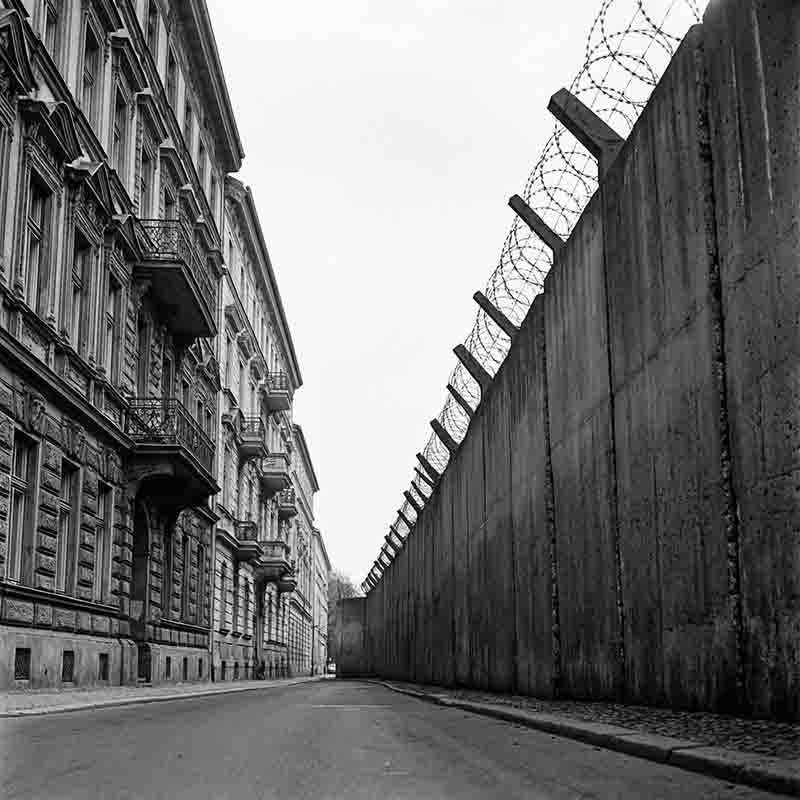
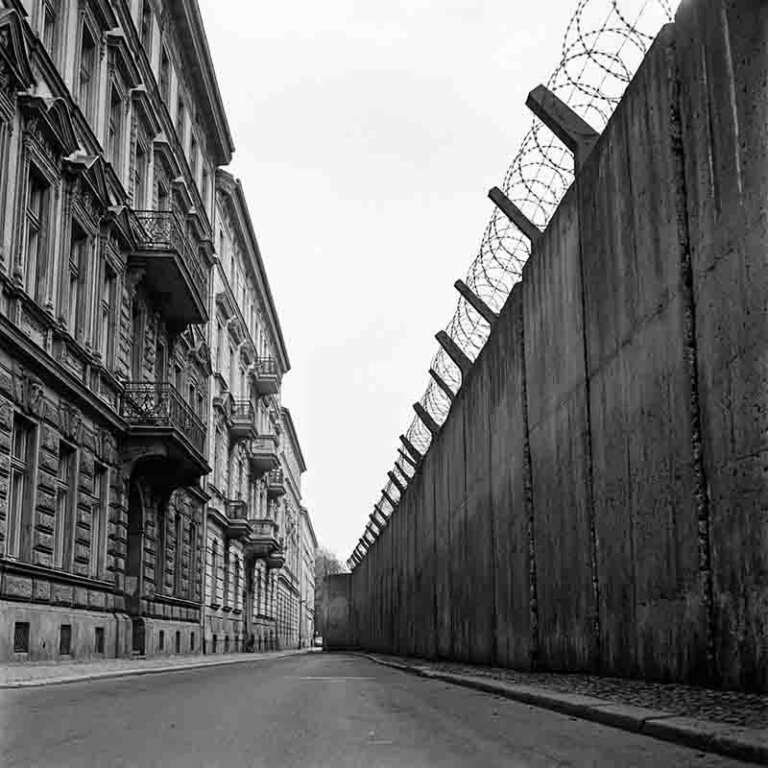
Berlin remained divided, with the Western sectors forming West Berlin, an enclave surrounded by East German territory. The city would remain a flashpoint for decades, eventually becoming the site of the Berlin Wall in 1961.
The wall would come later though. In 1945, the Allies had not set out with a clear plan to create two German states, but their disagreements and their increasingly incompatible political and economic systems had turned a temporary occupation arrangement into a permanent division that would last for more than four decades(!)
The irony lies somehwere in there. Germany, the country that had plunged Europe into one of the most destructive conflicts in history, had become one of the central battlegrounds of the next great international rivalry.
The United States and the Soviet Union had been allies because they shared an enemy. Once that enemy was defeated, the differences between them became impossible to ignore. Germany exposed those differences in a very practical way: one country, four occupying powers, four different priorities and no lasting agreement on what the future should look like.
The division of Germany was about territory as much as It was about security, ideology, economic recovery and the struggle for influence over Europe. This was the postwar world, where the United States and the Soviet Union, once two victorious allies, were becoming competing superpowers.
And Germany’s factories, machinery, scientists and technological expertise were about to become another part of that competition.
In our next article in this series, we’ll look at what happened to the industrial and scientific assets Germany left behind, including the factories dismantled and shipped east, the technology captured by the Allies, and the German rocket specialists who would help shape the American and Soviet space programmes. This is a story about the moon landing. But first, to understand how, and where, it all begun.