Kenya’s education reforms were supposed to usher in a new way of learning, one that moved away from the familiar examination driven system and placed greater emphasis on learners’ abilities and practical skills. But as the country continues implementing Competency Based Education (CBE), it is becoming clear that there is confusion about Junior School and who should be in charge of it.
This confusion has put two of Kenya’s largest teachers’ unions on opposing sides and reopened conversations about the structure of an education system that is still finding its feet.
At the centre of it all is the Kenya Union of Post Primary Education Teachers (KUPPET), which wants Junior Schools to operate independently of primary schools, with their own administration and leadership structures. The union has renewed its opposition to the government’s comprehensive school model, arguing that placing Grades 7, 8 and 9 under primary school headteachers does not adequately recognise the nature of Junior School education or the professional responsibilities of the teachers handling learners at this level.
It is a disagreement that has been boiling since Junior Secondary School was introduced in 2023 and with President William Ruto now pushing for legislation to formally anchor comprehensive schools in law, the debate seems to be boiling over.
It now no longer just about who gets to occupy the headteacher’s office but the future structure of basic education in Kenya.
To understand the current dispute, it helps to go back to the transition from the 8-4-4 education system.
For decades, Kenyan learners followed an eight year primary education programme before moving to four years of secondary school and eventually university or other forms of post secondary training. The introduction of the Competency-Based Curriculum (CBC) changed that familiar arrangement, introducing a structure that divides basic education into Early Years Education, Middle School and Senior School.
Under the new structure, learners progress through pre-primary, lower primary and upper primary before moving to Junior School, which covers Grades 7, 8 and 9. They then proceed to Senior School in Grade 10.
But while changing what children learn was one part of the reform, deciding where they would learn and who would manage the different levels presented another challenge.
In 2020, the taskforce chaired by Professor Fatuma Chege recommended that Junior Secondary education be domiciled in existing secondary schools. The idea was that learners moving out of primary education would continue their studies within a secondary school environment.
That recommendation, however, was not the final word.
Following its appointment in 2022, the Presidential Working Party on Education Reform, chaired by Professor Raphael Munavu, proposed a different arrangement. Its recommendation was to establish comprehensive schools bringing together pre-primary, primary and Junior School education under one administration.
The reasoning was largely practical. Rather than require the government to construct entirely new institutions for Junior School, existing primary school infrastructure could be used to accommodate the additional grades. It would also make the transition from Grade 6 to Grade 7 easier by allowing learners to remain within familiar school environments.
The government adopted this arrangement, and in 2023, the first cohort of CBC learners transitioned into Grade 7. In practice, therefore, primary school headteachers became the heads of comprehensive schools, with deputies overseeing the different sections. Junior School was therefore accommodated within primary school institutions rather than established as an entirely separate administrative entity.
It was a decision that made logistical and financial sense to the government, but which would later be the bone of contention.
Why does KUPPET want Junior Schools separated?
KUPPET’s argument is that Junior School is fundamentally different from primary education and should be managed accordingly.
The union maintains that teachers handling Grades 7 to 9 are largely trained to teach at the secondary school level. They handle a different curriculum, specialised learning areas and practical subjects that require appropriate facilities and a management structure capable of supporting the demands of Junior School education.
For the union, placing these teachers under primary school headteachers creates an administrative mismatch.
Its position is that Junior Schools should have their own principals, deputy principals and independent management structures, even where they continue sharing physical compounds with primary schools.
In other words, KUPPET is not necessarily demanding that every Junior School be moved into a new compound or that the government construct separate buildings. It wants institutional independence, with distinct leadership and management responsibilities.
The union also argues that autonomy would allow Junior Schools to manage their resources more effectively, strengthen the delivery of practical and co curricular learning, and give teachers a clearer professional identity and career progression pathway.
This is not an entirely new demand as Junior School teachers have previously demonstrated over administrative autonomy, among other concerns, including employment terms and working conditions.
At its 28th Annual Delegates Conference in Diani in November 2026, KUPPET renewed its opposition to the comprehensive school arrangement, with Secretary General Akelo Misori and union officials insisting that Junior Schools should operate independently.
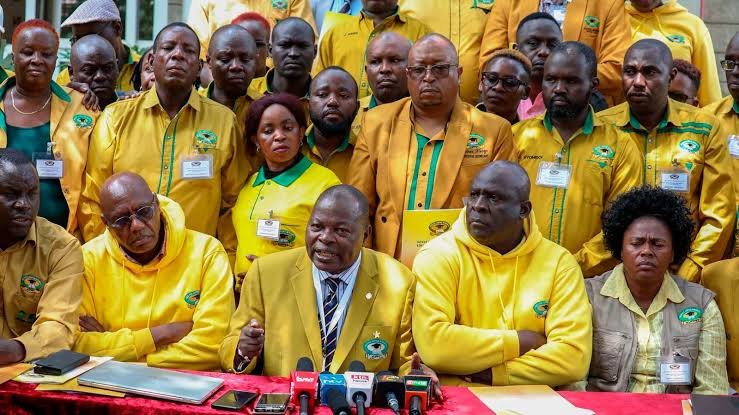
The union has also challenged the constitutional and legal basis of the current arrangement, arguing for distinct categories of public primary, junior and senior schools rather than one institution combining multiple levels.
For KUPPET, the issue is about recognising Junior School as a distinct stage of education with its own professional and institutional needs.
KNUT Disagrees
While KUPPET is pushing for separation, the Kenya National Union of Teachers (KNUT) supports the comprehensive school model.
KNUT’s argument is that having one administration overseeing learning from Early Childhood Development Education (ECDE) through to Grade 9 provides continuity and makes better use of available resources.
The union believes that separating primary and Junior School administration could introduce unnecessary duplication, increase government expenditure and create divisions within the teaching profession, a position that is also supported by primary school heads, who have argued that one head of institution, assisted by deputies responsible for the different sections, is a more practical way to manage comprehensive schools.
Their concern is that schools are already dealing with infrastructure gaps, competing financial demands and the challenge of implementing a new curriculum. Creating separate administrative structures could mean additional leadership positions, operational costs and potentially more complicated resource allocation.
The Kenya Comprehensive Schools Heads Association (KECSHA) has maintained that the comprehensive school model should be strengthened rather than dismantled.
The disagreement was particularly evident during the November 2026 discussions involving school heads and education stakeholders in Mombasa. KNUT Secretary General Collins Oyuu strongly defended the one school arrangement, arguing that the different sections should work together rather than be separated.
This leaves the education sector with two competing visions. One sees Junior School as a distinct institution that requires independent management while the other sees it as an integral part of a continuous basic education structure, with both sides arguing that their preferred arrangement would ultimately benefit learners.
The government is right at the Middle
The debate has become even more significant following President William Ruto’s November 12, 2026, directive to the Ministry of Education.
Speaking during the Kenya Comprehensive Schools Heads Association conference in Mombasa, the President directed the ministry to work with the association and prepare proposals within 90 days to amend the Basic Education Act.
The proposed amendments are intended to provide a clearer legal framework for the governance, staffing and financing of comprehensive schools.
The announcement is significant because it signals the government’s intention to formally entrench the comprehensive school model in law.
It also comes at a time when the proposed Basic Education Bill, 2026, is being discussed through public participation forums across the country. The Bill seeks to overhaul the Basic Education Act of 2015, with its proposed provisions on school leadership emerging as one of the contentious issues.
During these consultations, KUPPET has called for references to comprehensive schools to be removed and replaced with provisions establishing independent Junior Schools. KNUT, on the other hand, supports retaining the current management arrangement.
The Teachers Service Commission (TSC) has also maintained that primary school headteachers should remain the substantive heads of comprehensive schools, a position that does not align with KUPPET’s demands.
The government’s position is therefore particularly important. While it has committed to developing a legal framework for comprehensive schools, it must also consider the concerns raised by teachers, school administrators, parents and other stakeholders.
And then ofcourse, there is the issue of financing.
The government has proposed consolidating funding for primary and Junior School sections as part of strengthening the comprehensive school model. President Ruto announced that primary school capitation would increase from KSh1,420 to KSh2,300 per learner annually, while Junior Schools currently receive KSh15,042 per learner annually. This raises further questions about how money will be allocated, accounted for and managed within institutions that have different learning requirements.
For KUPPET, administrative independence is closely tied to the ability of Junior Schools to manage their own affairs. For supporters of the comprehensive model, however, shared administration and coordinated funding could make institutions more efficient.
But, what does this mean for parents and learners?
It is easy to look at the disagreement as another dispute between teachers’ unions, school heads and the government. But the decisions being made will ultimately shape the learning environment for millions of Kenyan children.
For parents, one of the biggest concerns is whether the debate will translate into meaningful improvements in the quality of education.
Junior School is a particularly important stage in a learner’s development. It is where children begin developing practical skills and identifying their interests as they prepare for Senior School.
The curriculum requires more than classrooms and textbooks, calling for laboratories, workshops, appropriate learning materials, specialised teachers and opportunities for learners to develop their talents.
If an independent administrative structure makes it easier to plan for and provide these resources, then KUPPET’s argument deserves serious consideration.
But if separating Junior Schools results in duplicated administrative costs without improving the actual learning experience, the government would have to question whether the additional expenditure is justified.
There are also practical questions about shared facilities. If primary and Junior School learners occupy the same compound, how will laboratories, libraries, playing fields and other resources be managed? Would separate administrations make coordination easier or introduce another layer of bureaucracy?
And perhaps most importantly, how will the government ensure that the debate over institutional management does not distract from the actual work of implementing CBE?
All of these questions deserve answers beyond the competing positions of teachers’ unions.
The battle over Junior School administration exposes a larger challenge facing Kenya’s education reforms: changing a curriculum is one thing, but building the institutional structures to support it is another.
The comprehensive school model was introduced partly to address infrastructure and transition challenges. It was a practical response to the realities of implementing a new education system across thousands of institutions.
However, as the model takes shape, questions are emerging about whether the administrative structure is adequately equipped to meet the needs of all the learning levels it brings together.
KUPPET wants a rethink. KNUT and school heads want continuity. The government wants a legal framework that provides certainty on how comprehensive schools should operate.
What happens next will depend on the proposed amendments to the Basic Education Act and how the government responds to the concerns raised during public participation.
What is clear though, is that Junior School is no longer simply a new stage in Kenya’s education structure and has become the centre of a much bigger debate about leadership, professional recognition, public spending and the future of CBE.