Imagine scrolling through your phone during the 2027 election campaign and coming across a video of a presidential candidate making a shocking statement. The candidate appears to be standing at a podium and the voice is exactly right. The face looks right and the mannerisms are familiar.
Even the hands (one of those things that help some of us tell whether a video is AI on not) appear to be moving right.
Before you can even blink, the video goes viral and the expected reactions begin to pour. People are angry as whatsApp groups explode with arguments. Supporters of the candidate insist the video is fake while opponents insist it is proof of what they have always believed about the politician.
What if the candidate actually never said those words and the video was generated or manipulated using artificial intelligence? Will it matter, or the damage will have already been done?
This whole situation might seem unbelievable, but it is an uncomfortable question Kenya needs to start asking as the country moves towards the 2027 General Election.
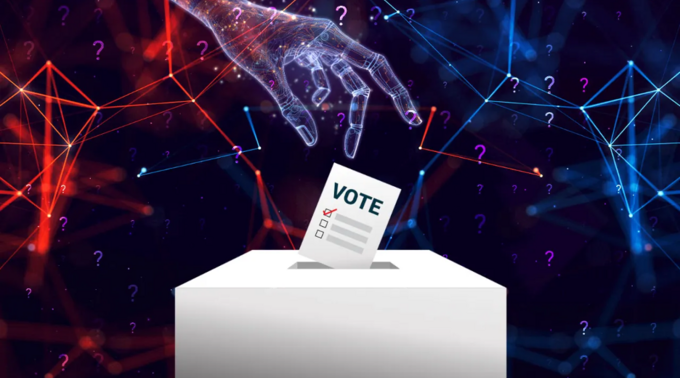
Could artificial intelligence change not only how politicians campaign, but how Kenyans decide who to vote for?
The answer, surprisingly, is yes.
AI has changed the political battlefield
Artificial intelligence has already moved far beyond chatbots that write emails and generate essays.
Today’s generative AI can create remarkably convincing photographs, videos, voices and speeches. A person’s face can be placed into a video and their voice can be cloned from relatively small amounts of audio. Images can be generated showing public figures in situations that never happened.
And increasingly, these technologies are finding their way into politics (case in point, the dancing videos of former Deputy president Gachagua and the current Deputy president, Mr Kindiki that have been flooding our timelines.)
In the United States, AI-generated political advertising is already becoming a major concern during the 2026 election cycle. One recent campaign advertisement used an AI generated version of a political opponent appearing to make controversial statements. Experts warned that the problem extends beyond people simply believing a fake video. AI can make people lose confidence in everything they see and hear – a distinction that is important.
You see, it’s not really about voters believing something false, but the possibility that they will eventually believe nothing at all.
What if a politician’s voice can be cloned?
Video deepfakes tend to get the most attention, but audio could become just as powerful. Imagine receiving a WhatsApp voice note that sounds exactly like a political candidate, with the voice announcing their withdrawal from the race, or endorsing another candidate.
Or insults a particular community.
Imagine if the voice claims that an election result has already been decided.
For someone listening casually on a phone, determining whether the voice is genuine could be extremely difficult (the older generation is already struggling with telling if that video of a dog cycling is real or not.)
AI generated voice technology has advanced rapidly, and researchers say synthetic voices are increasingly being used for impersonation, fraud and disinformation. Detecting them is itself becoming a difficult technical problem.
Kenya’s biggest advantage for political misinformation however, is that we already have a culture of forwarding things.
A convincing voice note does not need to remain online for long to become influential – just enter the right WhatsApp groups.
The WhatsApp problem
This is where Kenya’s political environment makes the AI question particularly interesting.
A piece of misinformation does not necessarily need to go viral on X, TikTok or Facebook to influence voters.
Someone receives a video from a friend and forwards it to a family group. Someone else sends it to a chama as another person posts it in a neighbourhood group. Meanwhile, a political supporter somewhere shares it with hundreds of contacts.
By the time someone asks whether the original video is authentic, it may already have travelled far beyond its original source.
AI makes this particularly dangerous because producing convincing misinformation is becoming cheaper and easier. A person who once needed professional editing skills, equipment and considerable time can now generate sophisticated synthetic content using tools that are increasingly accessible.
Research cited by African civil society organisations has already raised concerns about AI-driven disinformation ahead of the continent’s next electoral cycle. Kenya is among several African countries heading towards elections in 2027.
And let’s not even begin on photographs and how a photograph supposedly showing a politician meeting a controversial figure could become ammunition within minutes, as could an image showing a candidate appearing drunk, receiving money, visiting a particular location or participating in an event that never happened.
Remember when the saying used to seeing is believing? AI is making that advice dangerously outdated.
A photograph, video or even voice recording are no longer necessarily evidence that something happened.
AI could also create fake political speeches
There is another possibility that sounds almost absurd until you consider how quickly generative AI is improving.
A political candidate could appear to deliver an entire speech without ever having delivered it, with their face generated or manipulated.
Their voice could be cloned.
The finished video could then be distributed as though it were an authentic campaign appearance.
And this creates a particularly difficult problem for journalists, fact checkers and voters.
The most dangerous part may be what happens after the truth is discovered
There is a strange problem emerging with deepfakes.
Once people know that fake content exists, politicians may begin using that fact to dismiss genuine evidence.
A real video can be called AI-generated and a genuine recording can be described as a deepfake. An authentic photograph can be dismissed as manipulation.
This creates what some researchers describe as a broader erosion of trust.
And that could be more damaging to democracy than any individual fake video.
Because elections depend on citizens having some degree of confidence in the information they use to make decisions. If every inconvenient piece of evidence can simply be dismissed as AI-generated, the public conversation becomes much harder to anchor in facts.
Could AI influence voters without creating fake videos?
Absolutely. Deepfakes are only one part of the story.
AI can analyse enormous amounts of information about people and help political campaigns understand their interests, behaviour and concerns. It can be used to generate personalised messages, analyse voter sentiment and produce large amounts of campaign material.
Political campaigns around the world are already experimenting with AI for targeting, messaging and voter engagement.
And increasingly, voters themselves are turning to AI.
Instead of asking a political party, journalist or traditional search engine about a candidate, someone could simply ask an AI chatbot:
Who should I vote for?
Crazy, right? What happens when the machine answering that question gets something wrong or reflects bias in its training data?
What happens when it presents a confident but inaccurate description of a candidate?
Research published this year is already examining how large language models respond when asked to evaluate political parties and politicians, including whether their assessments change depending on how questions are framed(!)
AI is therefore not merely becoming a tool politicians can use to influence voters but also a tool voters use to understand politics.
Kenya is not starting from zero
Kenya has already experienced the political consequences of misinformation, manipulated content and highly sophisticated online propaganda.
AI does not create the problem from scratch but supercharges an existing one.
That distinction matters because in 2027 apart from teaching people what a deepfake is, a bigger challenge will be helping citizens develop a much stronger habit of questioning digital information before sharing it.
That means asking basic questions like who originally posted this? Where did the video come from? Can the claim be confirmed by another credible source?
Is there an original recording? Did reputable news organisations report the same event?Does the image actually show what the caption claims? And perhaps most importantly:
Why am I being encouraged to react so quickly?
Emotional manipulation is one of the oldest tools in political communication. AI simply gives it a much more powerful engine.
What about other countries? You may ask. Well, Kenya will not be the first country to confront this problem.
Brazil, which is heading into its October 2026 presidential election, has been grappling with AI-generated political material. Its electoral authorities have been working on rules covering synthetic content, including deepfakes used in political advertising.
Other countries have also introduced different approaches to AI generated campaign material, from disclosure requirements to restrictions on deceptive synthetic content.
But regulation has its own problem – technology moves quickly.
A rule written today may struggle to address a technology that becomes widely available tomorrow, therefore governments have to find a difficult balance between protecting elections from manipulation and protecting legitimate political speech.
So, can AI change how Kenyans vote?
It already has the potential to. The bigger question, therefore, is how much influence we allow it to have.
AI can make political communication faster, cheaper and more accessible. It can help campaigns analyse information and communicate with voters. It can potentially make political participation more interactive and accessible.
But the same technology can also manufacture evidence, imitate politicians, spread false information at extraordinary speed and make authentic information harder to distinguish from fabricated content.
The 2027 election could therefore introduce a strange new reality for Kenyan voters, where they have to learn to distrust their eyes and ears without becoming cynical about everything encountered online.
Si rahisi. And perhaps that is the real AI election challenge.
The greatest threat may not be convincing Kenyans to believe something that never happened, but creating a political environment where Kenyans no longer know what happened at all.
The AI question is bigger than elections
This is part of a much larger conversation about how artificial intelligence is changing politics, healthcare and society.
Previously, we looked at whether AI can diagnose diseases better than doctors, including where artificial intelligence is proving useful and where human judgement remains essential.
We have also explored the bigger question of whether Africa could ever be governed by artificial intelligence.
At this point though, the biggest (and scariest question is; What happens when AI stops simply helping us make decisions and starts influencing the decisions we make?