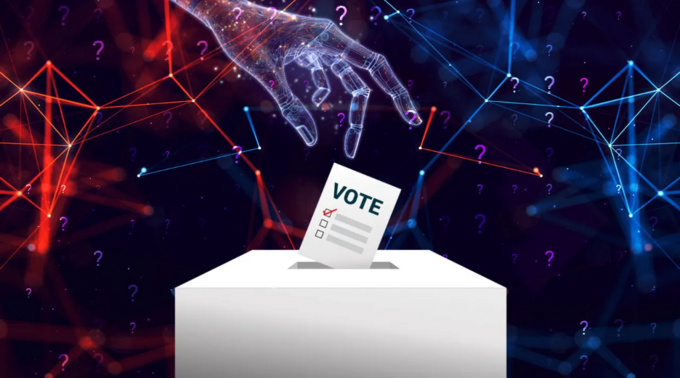
Artificial intelligence has already entered Kenya’s political conversation, and it may not look the way many of us expected.
Anthropic, the company behind Claude, says it uncovered a Kenyan political astroturfing operation in which AI was used to produce large volumes of social media content designed to look like genuine public conversation.
According to the investigation, the actors provided political topics, talking points and hashtags, then used Claude to turn them into batches of 50 themed social media posts ready for publication. The network used fake accounts and local influences to push coordinated political narratives.
Among the messages identified were claims that Kenya’s opposition coalition was falling apart ahead of the 2027 General Election, alongside content targeting opposition figures including Rigathi Gachagua and former president Uhuru Kenyatta.
The operation also used hashtags such as #PowerReliefKE and #PoweringTheNewKenya to amplify its messaging.
Anthropic said it believed the activity was a local Kenyan political operation whose pro-administration tone suggested it was plausibly aligned with the ruling coalition, although it did not identify the organisation behind it. The company also said the operation remained isolated within a network of fake accounts and did not ultimately reach or influence people at scale.
AI has changed the political battlefield
We often imagine AI’s political threat as a convincing fake video of a politician saying something they never said. That is certainly a possibility – but AI can also be much quieter.
One person can provide a political talking point and have AI turn it into dozens of posts, each written slightly differently. Those posts can then be distributed through multiple accounts, creating the impression that many different people are independently having the same conversation.
The grass is fake, but from a distance, it can look very real.
Kenya has seen political astroturfing and coordinated social media campaigns before. What AI changes is the speed and scale at which some of these tactics can operate.
We have already explored the growing role of artificial intelligence in other areas, including whether AI can really diagnose diseases better than doctors.
We have also looked at the bigger question of whether Africa could ever be led by AI.
Politics, however, brings a different kind of risk because ultimately, political information influences people.
And people vote.
Enter the deepfakes
Imagine a video appearing on TikTok or WhatsApp in which a presidential candidate appears to make a shocking announcement.
The face looks right, the voice sounds right and the video looks believable.
Except the politician never said it.
AI-generated images, videos and cloned voices are becoming increasingly difficult to distinguish from authentic content. A fake recording could make a politician appear to endorse something controversial, announce a resignation or attack an opponent.
The goal does not necessarily have to be convincing everyone. It only needs to convince enough people for long enough.
By the time someone proves that the video is fake, it may already have been downloaded, reposted and forwarded into hundreds of WhatsApp groups.
WhatsApp makes this even more complicated
Political information in Kenya does not only travel through public social media accounts.
It moves through private conversations too.
A suspicious video posted by an unknown account may not be particularly convincing. But the same video forwarded by a friend, relative or colleague comes with something more powerful: trust.
This is why AI-generated misinformation could be particularly difficult to contain during an election because it does not have to arrive looking like propaganda. It can arrive looking like someone simply sharing something they believe is important.
And sometimes the most effective misinformation will contain a little truth like say, a real photograph or a genuine speech. Maybe even an actual political disagreement.
AI can then be used to alter, exaggerate or repackage the material around a particular narrative.
AI could personalise political messages
There is another possibility that deserves attention. AI can make it easier to create different versions of the same political message for different audiences.
A message aimed at young voters could focus on jobs while another could focus on the cost of living. Another could appeal to business owners, farmers or people in a particular region.
Humans have always tailored political messages to their audiences. AI simply makes producing those variations much faster.
That raises an uncomfortable question of if, when we encounter a political post online, are we seeing someone’s genuine opinion, or a carefully generated message designed to make us feel or think a certain way?
Sometimes, we may never know.
But AI can also help fight misinformation
AI is not automatically the villain. The same technology can help journalists and researchers identify manipulated images, analyse coordinated networks and detect suspicious patterns.
Media organisations, fact checkers and election stakeholders are already preparing for the role that deepfakes and AI-generated misinformation could play in the 2027 election.
The real challenge is what happens when powerful technology meets political incentives, an information hungry public and social media platforms where false information can travel much faster than corrections.
So, could AI change how Kenyans vote?
Possibly, but it does not need to control an election to influence it.
It does not need to hack a ballot box or take over the electoral commission. It may simply need to influence what voters see, what they discuss, what they believe other Kenyans are thinking and which political stories dominate their feeds.
That is why the Kenyan operation uncovered by Anthropic is worth paying attention to.
It does not prove that AI has already manipulated Kenyan voters. In fact, the operation had limited reach.
But it does show that we no longer have to imagine AI being used in Kenyan politics. It is already being incorporated into political influence efforts.
As 2027 approaches, Kenyans will have to become much more careful about what they see and share online. Before forwarding that political video or screenshot, ask a few simple questions:
Who originally posted it?
Can the claim be confirmed elsewhere?
Does the account have a history?
Are several accounts suddenly pushing exactly the same message?
And perhaps most importantly:
Am I sharing this because it is true, or because it makes me angry?
In an election increasingly shaped by algorithms, the ability to pause before pressing Share may become one of the most important tools a voter has.
You see, it’s not really about voters believing something false, but the possibility that they will eventually believe nothing at all.
Kenya is not starting from zero
Kenya has already experienced the political consequences of misinformation, manipulated content and highly sophisticated online propaganda.
AI does not create the problem from scratch but supercharges an existing one.
That distinction matters because in 2027 apart from teaching people what a deepfake is, a bigger challenge will be helping citizens develop a much stronger habit of questioning digital information before sharing it.
What about other countries? You may ask. Well, Kenya will not be the first country to confront this problem.
Brazil, which is heading into its October 2026 presidential election, has been grappling with AI-generated political material. Its electoral authorities have been working on rules covering synthetic content, including deepfakes used in political advertising.
Other countries have also introduced different approaches to AI generated campaign material, from disclosure requirements to restrictions on deceptive synthetic content.
Si rahisi. And perhaps that is the real AI election challenge.
The greatest threat may not be convincing Kenyans to believe something that never happened, but creating a political environment where Kenyans no longer know what happened at all.