A claim circulating on social media suggests that women may one day be able to have children without sperm, with some posts pointing to the rete ovarii and research into female bone marrow as evidence. It sounds like the kind of discovery that could settle a few gender war arguments, but…..what are the scientists saying? Is a world where reproduction no longer requires contributions from both sexes a possibility in the near future?
The answer is more complicated than TikTok would have us believe.
What is the rete ovarii?
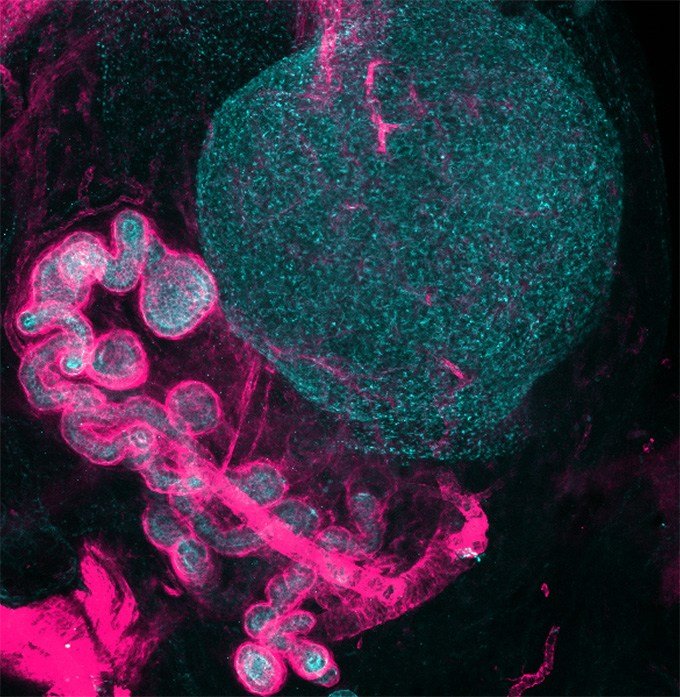
The rete ovarii is a small network of tubules found in the ovary. For a long time, it received little attention and was often described as a leftover structure from embryonic development with no clearly established function in adult life.
However, that understanding is beginning to change. Research published in eLife in 2025 examined the rete ovarii in mice and found evidence that it has secretory activity, suggesting that it may play a role in the ovarian environment. This is an interesting discovery, particularly because the structure has historically been overlooked. However, the research did not show that the rete ovarii produces sperm, creates eggs independently or enables reproduction without fertilisation.
So even though this little known ovarian structure has attracted renewed scientific interest, it is not evidence that women have a hidden biological mechanism for reproducing without sperm.
The 2009 research into bone marrow and sperm
This is where the viral claim has a more identifiable scientific starting point.
In 2009, researchers published a study investigating whether stem cells taken from human fetal bone marrow could be induced to develop characteristics associated with male reproductive cells. Using laboratory techniques, they reported that a small population of these cells appeared to develop into cells resembling early male germ cells, which are involved in the process that eventually produces sperm.
Yes, the researchers identified cells expressing markers associated with germ cell development, but they did not demonstrate that the cells had become fully functional sperm capable of fertilising a human egg and producing a child.
The study was an investigation into what stem cells might be capable of under laboratory conditions. It was not proof that a woman’s bone marrow could replace sperm in natural human reproduction.
So, where does the claim that women can reproduce without men come from? It appears to take an early stage scientific finding and extend it far beyond what the researchers demonstrated.
Scientists have already made mice with two biological fathers
Now, here is where it gets interesting.
The bone marrow story sounds speculative, but, there is another development in reproductive science that is much harder to dismiss.
In 2023, researchers published a study in the journal Nature describing how they created functional egg cells from male mouse cells. The team, led by Japanese scientist Katsuhiko Hayashi, used stem cells from a male mouse, converted their chromosome configuration from XY to XX in the laboratory and developed the resulting cells into eggs. After fertilisation, these eggs produced offspring.
Yes, you read that correctly – scientists produced mice with two biological fathers.
The achievement was significant because it demonstrated that, under carefully controlled laboratory conditions, cells originating from a male animal could be reprogrammed to produce eggs. It raised questions about the future of fertility treatment and whether same sex male couples might eventually be able to have children genetically related to both partners.
Ofcourse the catch is that this was a mouse experiment. The process involved complex laboratory techniques, and translating it into safe and effective human reproduction remains an enormous scientific challenge.
Can a woman produce a baby without sperm?
To answer this, we need to separate three ideas that social media frequently bundles together: becoming a parent without a male partner, an egg developing without fertilisation, and producing a healthy human baby without sperm.
A woman can absolutely become a parent without having a male partner. Donor sperm and assisted reproductive technologies already make this possible. However, sperm is still involved in the creation of the embryo.
There is also a biological phenomenon called parthenogenesis, in which an egg begins developing without being fertilised. This occurs naturally in some animal species and can be induced experimentally in others. In humans, however, activating an egg to divide is not the same as creating a viable pregnancy. Human development involves complex genetic processes, including genomic imprinting, which means that certain genes behave differently depending on whether they are inherited from the mother or the father.
Simply making an egg divide does not overcome these biological requirements.
Researchers are also exploring whether stem cells can be used to create reproductive cells in the laboratory. This field, known as in vitro gametogenesis, could eventually expand fertility treatment options. But creating cells that resemble eggs or sperm is only one step; scientists must establish that those cells can function properly and support safe, healthy development.
So, are men becoming biologically unnecessary? Aka Redundant?
Not yet, at least not in the way viral posts suggest.
The science is exciting precisely because it is pushing the boundaries of what researchers understand about reproduction. The possibility of producing eggs from cells that originated in a male mouse is a remarkable achievement. Research into stem cells and reproductive biology could also lead to new treatments for infertility.
But none of this establishes that women can currently reproduce with their own bone marrow instead of sperm, or that the rete ovarii makes sperm free human reproduction possible.
There is a difference between saying something has been demonstrated in a laboratory and saying it could become possible in the future. Social media often collapses that distinction, especially when a scientific discovery can be turned into ammunition for an argument about men and women.
Which is where the conversation becomes more interesting. Scientific discoveries do not need to prove that one sex is superior to the other to be worth discussing. Reproductive medicine is about understanding biology and exploring possibilities that could improve human lives.
The honest conclusion is that science is making fascinating progress, but the claim that women can have babies without sperm remains unproven (ladies, you will have to wait a little while longer.)
For now, the rete ovarii is an interesting ovarian structure, bone marrow research has produced intriguing early findings, and laboratory created eggs have led to live births in mice. Those are three separate scientific stories and not proof that women can reproduce without sperm.