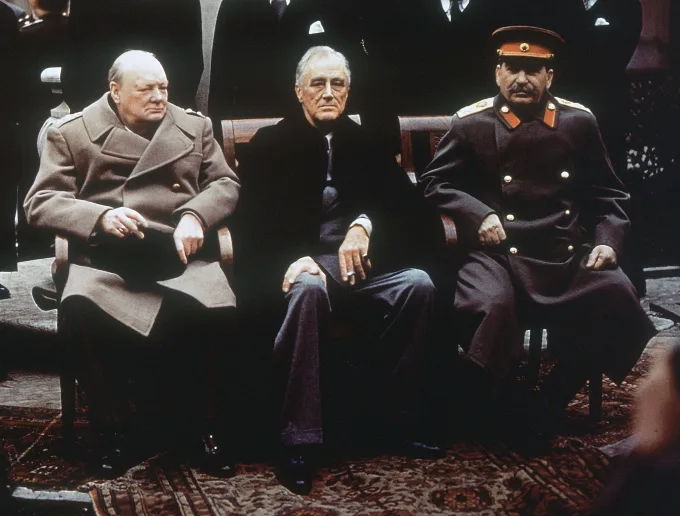
They had fought a common enemy, celebrated a shared victory and promised to build a peaceful world. But as the smoke cleared over Europe, the United States and the Soviet Union began to see each other as threats. A new conflict was taking shape, one that would divide the world for more than four decades.
How do nations that fought alongside each other and even shared the spoils of war now become so…..Cold towards each other?
When the Second World War ended in 1945, the world had every reason to hope that the worst was behind it. Nazi Germany had been defeated, Japan had surrendered and the victorious powers were beginning the enormous task of rebuilding countries devastated by years of fighting. The United Nations had been established and there was talk of a new international order that would prevent another war on such a devastating scale.
But things were not as rosy as was being potrayed. Beneath the celebrations and diplomatic handshakes, another kind of conflict was already taking shape.
The United States and the Soviet Union had emerged from the war as the two most powerful countries in the world. They had fought on the same side, but their alliance had been built around a common enemy rather than a shared vision of the future. Now that Nazi Germany was defeated, the political, economic and ideological differences between them were becoming harder to contain.
At this point, you are probably asking yourself, why? We keep talking of the Soviet Union and the United States as the emerging two super powers instead of three. What happened to Great Britain?
It’s a long story, perhaps one that deserves It’s own article. But briefly, here is why Britain keeps getting less and less mentioned.
You see, Britain entered the Second World War as one of the world’s leading imperial powers and emerged victorious in 1945. However, it was considerably weakened, heavily indebted and increasingly unable to exercise the kind of global influence it had enjoyed before the war.
The world was transitioning from the old to the new, and do you know what the most ironic part was? The same war that Britain helped win was the same war that accelerated the end of its position at the centre of global power.
For much of the nineteenth century, Britain was arguably the most powerful country in the world. It had led the Industrial Revolution, dominated international trade and colonised a quater of the world. And yet, it had won a war it could barely afford.
It was now reduced to seeking for assistance from the United States, and the scale of that assistance was enormous. The United States extended approximately $31 billion in Lend-Lease assistance to Britain during the war.
The country that had once been the world’s leading international creditor was now borrowing from a former colony.
If that doesn’t tell you how dramatically the balance of economic power had shifted, I don’t know what will.
The United States emerged from the war in a remarkably different position. Its mainland had not suffered the widespread destruction experienced in Europe. Its factories had expanded enormously to supply the Allied war effort. It had vast industrial capacity, enormous financial resources, a powerful navy and, from 1945, the atomic bomb.
The Soviet Union, meanwhile, had paid a devastating human price for victory. It had lost an estimated 26–27 million people and suffered immense destruction. Yet it emerged with the largest and most powerful land army in Europe, control over much of Eastern Europe and enormous political influence across the continent.
The United States and the Soviet Union possessed different kinds of power, but both had the military, industrial and political capacity to shape the emerging international order.
Britain on the other hand… despite still being a formidable power, could no longer match either of them across all those areas.
You can see now why historians increasingly describe the post war world as one dominated by two superpowers, rather than three.
Back to the topic at hand. Why were these former allies becoming so suspicious of each other? What exactly did they disagree about? And how did a world that had just survived one devastating war find itself preparing for another?
To understand the Cold War, we have to go back to the final days of the Second World War.
An alliance held together by a common enemy
The wartime relationship between the United States, Britain and the Soviet Union was an extraordinary partnership.
The Soviet Union had been invaded by Nazi Germany in June 1941, drawing it into a war that would cost the country tens of millions of lives. Britain had been fighting Germany since 1939, while the United States entered the conflict in December 1941 after Japan attacked Pearl Harbor.
Their political systems were vastly different. The United States was a capitalist democracy, while the Soviet Union was a communist one party state under Joseph Stalin. Britain was a parliamentary democracy with an empire that was already showing signs of strain.
They did not necessarily trust one another, but they needed one another to defeat Germany.
The Soviet Union wanted the Western Allies to open a second front in Western Europe to relieve pressure on the Red Army. The Americans and British eventually launched the Normandy landings in June 1944, while Soviet forces were pushing westward through Eastern Europe.
By the time Germany surrendered in May 1945, Soviet troops had occupied much of Eastern Europe, while American and British forces had advanced from the west. The two sides had effectively met in the middle of a devastated continent.
What would happen to the territories liberated or occupied by their armies?
For Stalin, the answer was closely tied to Soviet security. Germany had invaded Soviet territory in 1941, and the Soviet Union had suffered catastrophic losses. Stalin wanted a protective belt of friendly governments along the country’s western borders. He believed that countries in Eastern Europe should not become platforms from which another invasion could be launched.
For the Western Allies, however, this looked increasingly like an attempt to expand Soviet power across Europe.
Both sides spoke about security. Both believed the other was becoming a threat. And each interpreted the other’s actions through its own fears and historical experiences.
The wartime alliance was beginning to unravel.
Two systems that saw the world differently
At the heart of the Cold War was a fundamental disagreement about how societies and economies should be organised.
The United States championed capitalism and a political system based on multiparty elections. Its economy was built around private ownership, competition and market activity, although the government played an important role in regulating and supporting economic development.
The Soviet Union, on the other hand, operated under a communist system in which the state controlled major industries, production and economic planning. Political power was concentrated in the Communist Party, which did not permit genuine competition for national leadership.
It wasn’t just about the economy, as each side believed its system represented a better future for humanity.
American leaders feared that economic hardship, political instability and poverty could make countries vulnerable to communist movements and Soviet influence. Soviet leaders believed capitalism was inherently hostile to socialism and that Western powers would eventually seek to weaken or undermine the Soviet state.
There was also a question of power. The United States had emerged from the war with an enormous industrial advantage and, until 1949, a monopoly on nuclear weapons. The Soviet Union had the largest land army in Europe and controlled much of Eastern Europe through its military presence and political influence.
Neither side wanted to be vulnerable to the other.
The Cold War was a clash between competing political systems, national interests, security fears and visions of how the postwar world should be organised.
The Iron Curtain descends across Europe
By 1946, the growing division was becoming increasingly visible.
On 5 March 1946, former British Prime Minister Winston Churchill delivered a speech at Westminster College in Fulton, Missouri, in the presence of US President Harry Truman. Churchill warned that an Iron Curtain had descended across Europe, separating countries under growing Soviet influence from those aligned with the Western powers. A phrase that would become one of the most enduring descriptions of the Cold War.
Churchill was no longer Britain’s prime minister, having lost the 1945 general election, but he remained an influential political figure. His speech reflected growing Western concern about developments in Eastern Europe, where communist parties backed by Moscow were consolidating power.
Countries such as Poland, Hungary, Romania and Bulgaria were increasingly coming under communist control. Political opponents faced intimidation, opposition parties were weakened or pushed aside, and elections did not always offer genuine political choice.
Czechoslovakia, which had initially retained a multiparty political system, would experience a communist takeover in February 1948.
From the Soviet perspective, these developments were part of creating a secure neighbourhood after the devastation of the war. From the Western perspective, they looked like evidence that Stalin intended to extend Soviet control beyond the territories occupied by the Red Army.
The phrase Iron Curtain gave a name to a division that was beginning to shape the everyday lives of millions of Europeans.
America decides to contain communism
The United States was increasingly concerned that the economic and political instability of postwar Europe could create opportunities for communist expansion.
In March 1947, President Harry Truman addressed the US Congress and outlined what would become known as the Truman Doctrine.
The immediate concern was Greece and Turkey. Britain had been supporting the Greek government in its struggle against a communist led insurgency, as well as providing assistance to Turkey amid pressure from the Soviet Union. The same Britain that was financially exhausted after the war and could no longer sustain the level of assistance required. Enter The United States.
Truman asked Congress to approve $400 million in military and economic assistance for Greece and Turkey. He argued that America should support countries resisting attempts to be brought under the control of armed minorities or outside pressure.
This became the foundation of the American policy of containment: preventing the spread of Soviet influence and communism beyond the areas where it had already taken hold.
The policy would shape American foreign relations for decades. It would influence decisions in Europe, Asia, Latin America and elsewhere, and eventually become part of the reasoning behind American involvement in conflicts such as the Korean and Vietnam wars.
To Washington, containment was necessary to stop Soviet expansion. To Moscow, it was evidence that the United States intended to surround and weaken the Soviet Union.
The Marshall Plan: Rebuilding Europe, or drawing a line?
While the Truman Doctrine focused on containing communism through political and military support, another American initiative would use economic recovery as a way of shaping Europe’s future.
In June 1947, US Secretary of State George C. Marshall proposed a major programme of economic assistance to help rebuild Europe.
The continent was still struggling with destroyed infrastructure, damaged industries, food shortages, unemployment and housing crises. Many countries were financially weakened and unable to rebuild without outside assistance.
The proposal, which became known as the Marshall Plan, was formally approved in 1948. The United States eventually provided approximately $13.3 billion in assistance to participating European countries between 1948 and 1952.
The programme helped restore industries, improve infrastructure and revive trade. It also created markets for American goods and strengthened economic relationships between the United States and Western Europe.
The offer was not initially presented as an exclusive arrangement for Western Europe. The Soviet Union and Eastern European countries were invited to participate. As expected, Stalin rejected the proposal and pressured governments within the Soviet sphere to stay away.
Moscow viewed the Marshall Plan with suspicion, believing that American economic assistance could create political dependence and extend Western influence into Eastern Europe.
The result was another dividing line. Western European countries participated in the recovery programme, while the Soviet Union and its Eastern European allies pursued reconstruction through their own economic arrangements.
The Marshall Plan was an economic recovery initiative, but it also became an important instrument in the emerging geopolitical contest. It helped strengthen Western European economies at a time when the Soviet Union was consolidating its influence in the East. Harry S. Truman+1
Germany becomes the centre of the confrontation
By this point, Germany had become one of the clearest examples of the growing divide.
The four occupation powers were increasingly pursuing different policies in their respective zones. The Soviet Union was restructuring its zone along socialist lines, while the United States, Britain and France were moving towards economic cooperation and political reconstruction in their areas.
The Western powers believed a stable and economically viable Germany was essential to Europe’s recovery. The Soviet Union feared that a revived Germany, closely aligned with the West, could once again become a military threat.
The disagreement eventually reached a breaking point in 1948.
The Western Allies introduced a new currency, the Deutsche Mark, in their occupation zones as part of efforts to stabilise the economy. The Soviet Union opposed the move and responded by blocking road, rail and water access to the Western controlled sectors of Berlin.
Berlin was deep inside the Soviet occupation zone, but its western sectors were still controlled by the United States, Britain and France.
The blockade began on 24 June 1948. The Western powers responded with an extraordinary operation that became known as the Berlin Airlift, flying food, fuel and other essential supplies into the city.
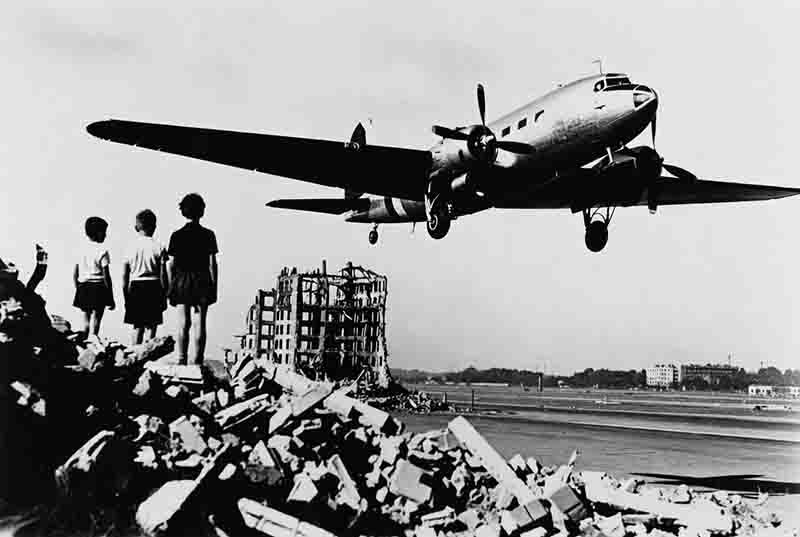
The crisis lasted until 12 May 1949, when the Soviet Union lifted the blockade.
It was one of the first major confrontations of the Cold War, and it demonstrated how close the former allies had come to a direct clash. The Berlin crisis also accelerated the political division of Germany, which became two separate states in 1949.
The story of the divided country we explored in our second article was no longer simply about how the Allies had chosen to administer a defeated Germany. It had become a reflection of the wider struggle between two competing world powers.
The birth of NATO and the hardening of the divide
The growing mistrust was also changing the military and diplomatic relationships of the postwar world.
On 4 April 1949, twelve countries signed the North Atlantic Treaty in Washington, establishing the foundation of what would become the North Atlantic Treaty Organization, better known as NATO.
The founding members included the United States, Canada, Britain, France, Belgium, the Netherlands, Luxembourg, Denmark, Norway, Iceland, Italy and Portugal.
The central principle was collective defence. An attack against one member would be treated as an attack against all, although each country would determine what action it considered necessary in response.
For Western European countries, the arrangement offered reassurance that the United States would not withdraw from Europe’s security after the war. It also provided a framework for cooperation among countries that feared further Soviet expansion.
For the Soviet Union, NATO looked like the creation of a military alliance directed against it.
The alliance was not the only reason for the growing confrontation, but it formalised the Western security partnership and gave the emerging division a military structure.
The Soviet Union would later establish the Warsaw Pact in 1955, bringing together itself and its Eastern European allies in a rival military alliance. Europe was becoming organised into two opposing blocs.
A war without a formal battlefield
The Cold War. Ever wondered how this unusual term came about? Well, maybe a look at the unusual confrontation would help.
Unlike the two world wars that had preceded it, the United States and Soviet Union did not engage in a full-scale direct military war against each other. Instead, they competed through military alliances, intelligence operations, propaganda, economic influence, scientific research, technological development and support for opposing sides in conflicts around the world.
There were moments when the confrontation came dangerously close to becoming a direct war. There were also devastating conflicts in other countries, where the two superpowers supported rival governments, movements and armies.
The Korean War, which began in 1950, would become one of the first major armed conflicts of the Cold War. The United States and its allies supported South Korea, while North Korea received support from the Soviet Union and China. The conflict would leave the Korean Peninsula divided and cost millions of lives.
Elsewhere, the competition would influence political struggles and wars in Asia, Africa, Latin America and the Middle East.
The superpowers were not always fighting each other directly, but their rivalry was felt far beyond Europe.
And let us not forget the whole nuclear situation.
The United States had used atomic bombs against Hiroshima and Nagasaki in August 1945, becoming the first country to possess nuclear weapons. The Soviet Union successfully tested its first atomic bomb on 29 August 1949, ending America’s nuclear monopoly.
The development of increasingly powerful weapons would create a dangerous situation in which both sides had the ability to inflict catastrophic destruction on the other.
Military planners began thinking not only about how to win a war, but also about how to prevent one. The idea of nuclear deterrence would become central to Cold War strategy.
The race was about to move beyond Earth
By the end of the 1940s, the rivalry between the United States and the Soviet Union was no longer confined to arguments about Europe, political systems or military alliances.
Both countries were investing heavily in science, engineering, missiles, aircraft and nuclear technology. The development of long-range rockets was particularly important because it offered the possibility of delivering weapons across continents(!) And is where the story of the German scientists and technology we explored in our previous article becomes especially significant.
The V-2 rocket had demonstrated the potential of long range rocket propulsion. American and Soviet engineers were now building on that knowledge, developing more powerful missiles that could eventually travel far beyond the range of the original German weapon.
At first, the immediate priority was military. But rockets capable of travelling enormous distances also raised another possibility: could they carry an object into orbit around the Earth?
Could a country demonstrate its scientific superiority by sending something into space before its rival?
Remember, this was now becoming a battle of the egos.
Could the same technology developed for military competition become the vehicle through which humanity explored the universe?
These questions would soon move from laboratories and military research centres into the public imagination.
In October 1957, the Soviet Union launched Sputnik 1, the world’s first artificial satellite. A small metal sphere began circling the Earth, sending out radio signals that could be detected by people on the ground.
It was a remarkable scientific achievement, but it was also a political statement. The Soviet Union had demonstrated that it possessed the rocket technology to place an object into orbit.
The Americans were stunned.
The Space Race had begun.
The Cold War had started as a struggle over the future of Europe and the balance of global power. It was now reaching beyond the atmosphere, carrying with it the same ambitions, fears and national rivalries that had shaped the postwar world. Soon, the competition would no longer be about who could build the most powerful weapon or influence the most countries but who could reach space first, who could send a human being beyond Earth and ultimately, who could plant a flag on the Moon.