This is one of those highly controversial topics, so I am going to gear up.
Remember how we used to watch all those science fiction films, the ones that looked so unrealistic while promising us a future that felt impossibly distant. We were in awe as computers diagnosed illnesses in seconds, robots assisted surgeons in futuristic hospitals and intelligent machines made life or death decisions with a precision that was out of this world. Fascinating entertainment by all means, and few of us imagined we would live long enough to see those ideas become reality. Yet here we are.
The future we once associated with Hollywood blockbusters is no longer confined to the big screen. Artificial intelligence has quietly found its way into our homes, our workplaces and, increasingly, our hospitals. It is even being touted as a tool that might change voting patterns. AI is helping doctors interpret medical scans, identify diseases earlier than ever before and support decisions that could save lives. What once seemed like science fiction is now becoming part of everyday medicine.
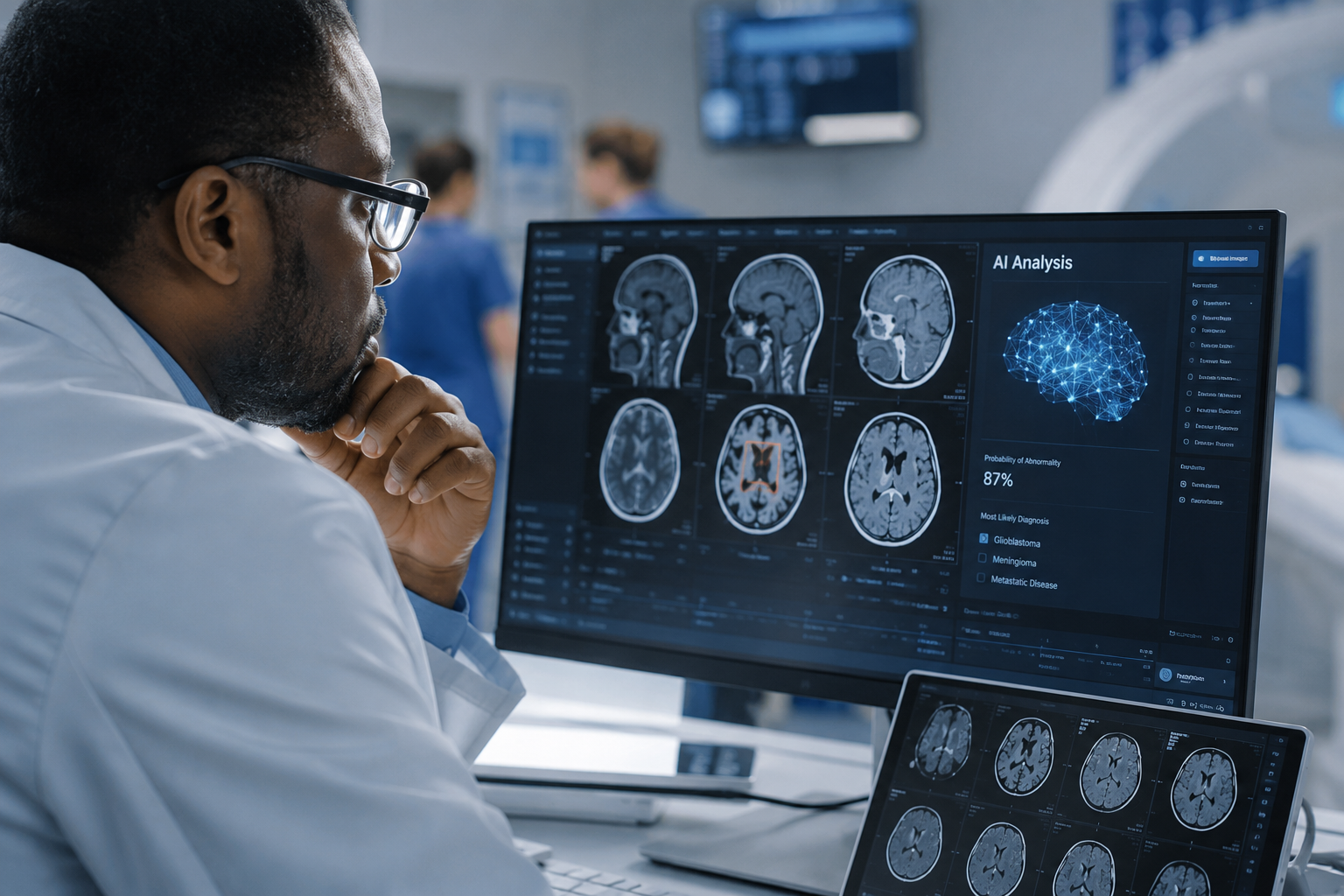
Picture this. A woman walks into a hospital complaining of persistent headaches and even before she sits across from a doctor, her brain scan has already been analysed by artificial intelligence. Within seconds, the system highlights an abnormality that might have taken a human specialist much longer to detect. In another part of the world, a smartphone app examines a photograph of a suspicious mole and warns its user that it could be cancerous. Elsewhere, AI identifies signs of diabetic eye disease before a patient notices any changes to their vision.
Just a decade ago, these scenarios would have sounded like scenes from a science fiction film. Today, they are becoming part of modern healthcare.
Artificial intelligence is rapidly transforming medicine. Hospitals are using it to analyse medical images, predict disease risks, streamline administrative work and even assist doctors in making clinical decisions. As the technology becomes more sophisticated, we find ourselves asking; can AI diagnose diseases better than doctors?
It is a fascinating question, but perhaps not for the reasons many people think. Popular culture often presents the debate as a competition between humans and machines, as though one will eventually replace the other. The reality is far more nuanced. Artificial intelligence is remarkably good at certain medical tasks, sometimes outperforming even experienced specialists. Yet there are equally important areas where human doctors remain irreplaceable.
Understanding where AI shines and where it falls short is essential, particularly at a time when millions of people are turning to AI tools for health advice before speaking to a healthcare professional.
Why AI Is So Good at Detecting Disease
One fact remains constant, that Artificial intelligence does not diagnose illness in the same way a doctor does. It does not rely on intuition or years of clinical experience. Instead, it learns by analysing enormous amounts of data. Modern AI systems can study millions of X-rays, MRI scans, CT scans, blood test results and patient records, allowing them to recognize patterns that would be almost impossible for a human being to memorise. The more high quality data an AI model processes, the better it becomes at identifying subtle abnormalities.
This ability has made AI particularly effective in image based medicine.
Researchers have developed AI systems capable of detecting breast cancer from mammograms, identifying diabetic retinopathy from retinal photographs, spotting early signs of lung cancer on CT scans and recognising strokes on brain imaging within minutes. In many studies, these systems have matched or even exceeded the diagnostic accuracy of experienced radiologists under controlled conditions.
The reason is simple. When a radiologist reviews hundreds of medical images in a single day, fatigue might become inevitable. Artificial intelligence, however, does not become tired, distracted or rushed. It examines every image with the same level of consistency, making it particularly valuable as a second pair of eyes.
Medicine Is More Than Finding Patterns
As impressive as AI is, diagnosing disease involves far more than interpreting images or analysing laboratory results.
When doctors listen to patients they may notice hesitation, fear and confusion. They ask follow up questions that uncover important details and consider a patient’s family history, lifestyle, occupation, emotional wellbeing and social circumstances before reaching a conclusion.
Two people may arrive at a clinic with identical symptoms, yet their underlying conditions could be completely different.
A persistent cough, for example, could be caused by pneumonia, asthma, tuberculosis, allergies, acid reflux, medication side effects or even prolonged exposure to air pollution. Determining the correct diagnosis often requires careful conversation, physical examination and clinical judgement rather than data analysis alone. Medicine is as much about understanding people as it is about understanding disease, and that is where human doctors continue to hold a decisive advantage.
The Human Element That AI Cannot Replicate
Imagine receiving life changing news. Perhaps it is a cancer diagnosis or confirmation of a chronic illness that will require lifelong treatment. Delivering that information is not simply a matter of reading test results. It requires compassion and the ability to answer difficult questions with honesty and sensitivity.
Patients often need reassurance as much as they need medication. They want someone to explain what their diagnosis means, discuss treatment options, address fears and support them through uncertainty. And that right there is the biggest difference. Artificial intelligence can neither hold a patient’s hand nor recognize the comfort provided by eye contact, the reassurance in a doctor’s tone or the trust built through genuine human connection.
Healthcare is ultimately about people, and people need more than accurate algorithms.
But AI Is Already Helping Doctors Save Lives
The conversation should not focus solely on whether AI can outperform doctors. Again, it is not a competition of who can out perfom who. In many hospitals around the world, the technology is already proving invaluable because it helps doctors make faster and more informed decisions.
Emergency departments are using AI to prioritise urgent cases. Pathologists are using it to identify cancer cells more efficiently and researchers are relying on AI to accelerate drug discovery. Meanwhile, hospitals use predictive models to identify patients who may be at risk of complications before their condition deteriorates.
In countries facing shortages of specialist doctors, AI also has the potential to improve access to healthcare.
For example, artificial intelligence can assist healthcare workers in screening chest X-rays for tuberculosis, helping identify patients who require further testing. AI-powered retinal screening tools can detect diabetic eye disease in communities where ophthalmologists are scarce. Similar technologies are being explored to improve maternal healthcare, strengthen disease surveillance and expand access to specialist expertise through telemedicine.
Rather than replacing healthcare professionals, these innovations allow limited medical resources to reach more people.
Should You Ask AI About Your Symptoms?
The growing popularity of tools such as ChatGPT has introduced a new trend. Many people now type their symptoms into an AI chatbot before deciding whether to visit a doctor. While there is nothing inherently wrong with seeking reliable health information online (AI can help people better understand medical terminology, explain common conditions and encourage them to seek professional care when appropriate) the danger arises when AI is treated as a substitute for medical evaluation.
Chatbots neither examine patients nor listen to the sound of a person’s breathing. They cannot feel an enlarged abdomen, detect weakness during a neurological examination or order diagnostic tests based on clinical findings. They rely entirely on the information users provide, and incomplete or inaccurate descriptions can easily lead to misleading conclusions.
There is also the risk of false reassurance. A person experiencing the early signs of a heart attack or stroke may delay seeking emergency care because an AI response suggested a less serious explanation. For this reason, healthcare professionals consistently emphasize that AI should support medical decision making as opposed to replacing it.
The Future Is Not AI Versus Doctors
For years, discussions about artificial intelligence have centred on one question: will machines replace human professionals? Healthcare suggests a different future.
The greatest strength of AI lies in its ability to process extraordinary amounts of information quickly and consistently while the greatest strength of doctors lies in their ability to apply clinical judgement, understand complex human situations and provide compassionate care.
These strengths complement rather than compete with one another.
An AI system may identify a tiny abnormality on a scan that could otherwise have been overlooked. A doctor determines whether that finding explains the patient’s symptoms, discusses treatment options, considers the person’s overall health and helps them make informed decisions. Neither works as effectively in isolation.
So, Can AI Diagnose Diseases Better Than Doctors?
The evidence suggests that artificial intelligence has already surpassed human performance in some highly specialised diagnostic tasks, particularly those involving pattern recognition and medical imaging. In those areas, AI is proving to be an extraordinary medical tool. However, diagnosing disease is rarely as simple as identifying an abnormal scan or recognising a familiar pattern.
Good medicine demands communication, critical thinking, ethical judgement, emotional intelligence and an understanding of the person behind the symptoms. Those qualities remain uniquely human.
Perhaps, then, we have been asking the wrong question all along. Instead of wondering whether AI can diagnose diseases better than doctors, we should be asking whether doctors equipped with AI can provide better care than doctors working without it. And increasingly, the answer appears to be yes.
Artificial intelligence is unlikely to replace the physician sitting across from you. What it is becoming, however, is one of the most powerful diagnostic partners medicine has ever known, helping doctors detect disease earlier, make more informed decisions and ultimately deliver better care to the people who need it most.