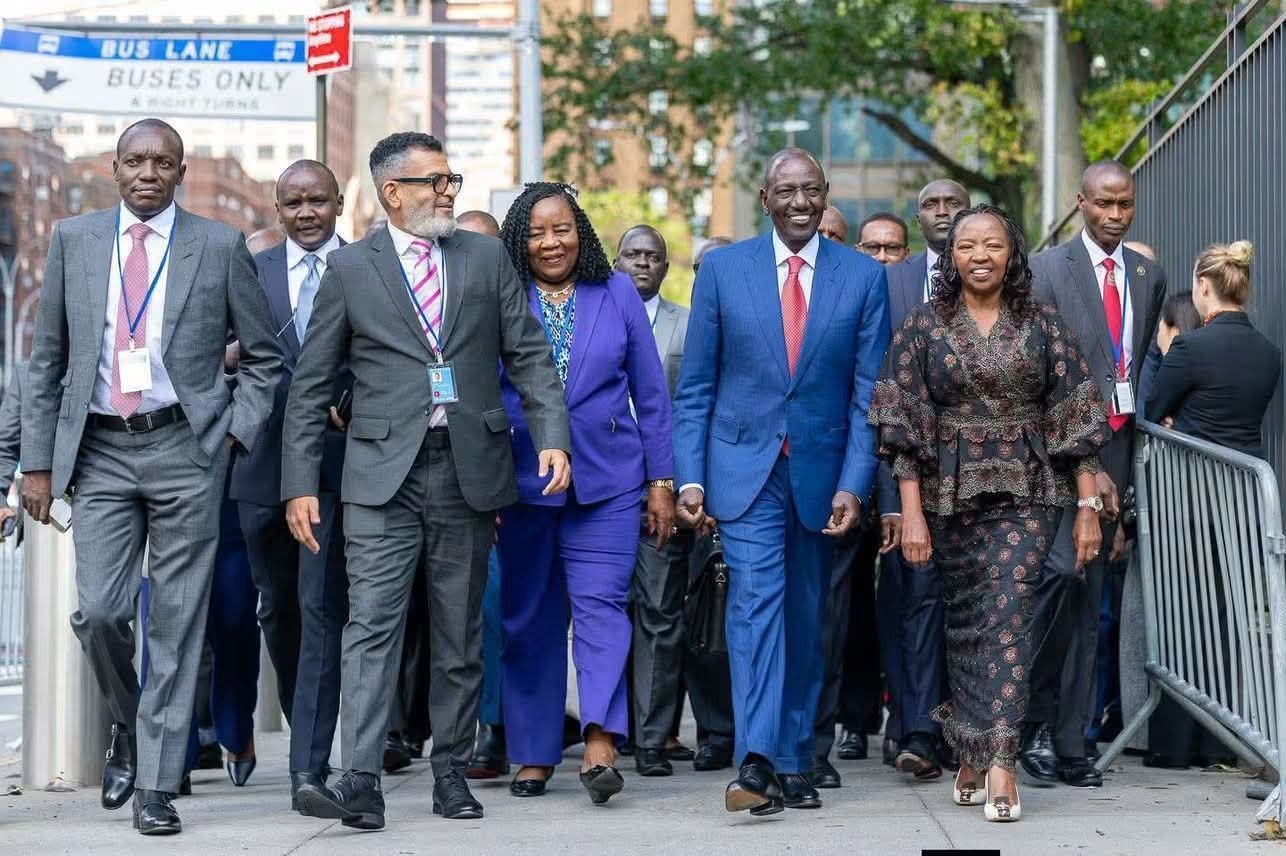
How many people did Kenya actually send to the 81st United Nations General Assembly in New York?
Nobody seems to know. Or, more accurately, Kenyans have not been told.
A figure of 81 delegates has been circulating online, while other claims suggest the actual number could be considerably higher once aides, secretaries, advisers, security personnel and other accompanying officials are included.
Ahead of the summit, the Ministry of Foreign Affairs confirmed that President William Ruto would lead Kenya’s delegation and said the country would use the high level gathering to pursue issues including debt sustainability, climate finance, digital trade, regional security and investment. The ministry, however, did not say how many people would travel as part of the delegation – and that missing number is beginning to matter.
UNGA is not a holiday but one of the most important diplomatic gatherings in the world, bringing together heads of state and global institutions. Kenya has every reason to be represented there, and by all means, the question is not whether Kenya should go.
The question is who exactly needs to go and how much does it cost the Kenyan taxpayer?
That question becomes particularly uncomfortable when you look at Kenya’s economic position.
The latest IMF figures show that as of June 30, 2026, Kenya had about 2.85 billion SDRs in outstanding IMF credit, making it the third largest IMF debtor in Africa after Egypt and Côte d’Ivoire. Ghana was fourth.
While that does not mean Kenya borrowed money from the IMF to send officials to New York, it does raise a broader question about priorities.
How much should a country carrying billions of dollars in IMF obligations be spending on official travel and overseas entourages? And why should the public have to piece together the size of a delegation from social media posts and photographs instead of being given the figure by the government itself?
The timing makes the question even harder to ignore.
Back home, Kenyan university lecturers have just issued a seven-day strike notice, threatening to shut down public universities from October 2 over the stalled 2025–2029 Collective Bargaining Agreement. UASU says the government has failed to provide a financial commitment for the agreement and has not honoured commitments contained in the November 2025 return to work formula.
So while Kenyan officials are in New York talking about transforming global institutions, managing debt, attracting investment and restoring trust, Kenyan lecturers are preparing to down their tools over an unresolved pay agreement. This comes just after another strike ended a few weeks ago – and this time it was nurses on strike.
There is something deeply uncomfortable about that contrast, which is also why the question of the UNGA delegation should not be dismissed as petty politics or jealousy about government officials travelling abroad.
Kenyans are entitled to ask what their government spends on official travel, particularly when the government is simultaneously asking the country to live within its means.
If the delegation was 81 people, tell us. If it was more than 81 because officials travelled with aides and support staff, tell us.
If different government departments sent separate teams to New York, tell us that too.
And if the cost was justified by the investment, diplomatic agreements and international partnerships Kenya secured, show Kenyans what was achieved and what it cost.
That is how public accountability is supposed to work.
And let us not even begin on African politic shenanigans as a whole. Across the continent, governments routinely send large entourages to international summits while citizens at home grapple with unemployment, high living costs, overstretched public services and strikes. Yet the same governments arrive at international meetings speaking passionately about poverty, debt, development and the need for a fairer global financial system!
Kenya’s participation at UNGA 81 may well produce worthwhile diplomatic and economic results. President Ruto has already announced international engagements and investment related deals on the sidelines of the summit. Still, we do not not 81 delages travelling all the to Newyork, together with their Secretaries, personal assistants, wives and sidechicks.
If there is one thing someone these government officials are good at, it is embarrassing us on the global stage.