It usually begins with concern. For democracy maybe, but mostly concern for human rights. Concern for freedom and the well being of people who, until yesterday, barely made the evening news. Who ever genuinely cared for the people or the masses? There is always hidden interest, political or financial, but it is never about the people. And pretending that it is about democracy is the biggest facade because we all know – have come to understand rather – that democracy is a scam. Especially in Africa, but then that’s a story for another day.
Anyway, after all the hullabaloo about democracy and human rights, the tanks roll in; figuratively or otherwise. We are told, once again, that this is not a coup but an intervention. A necessary global adult stepping in because a sovereign nation has misbehaved by doing something unforgivable, like controlling its own resources.
Read on 👉 How Ibrahim Traoré Became a Symbol of African Liberation
Iran learned this in the 1950s when it nationalized its oil. It was never about tyranny but ownership. The punishment came swiftly, disguised as liberation.
Muammar Gaddafi made the mistake of imagining an African gold backed currency, a financial heresy in a world where power is carefully denominated elsewhere, by a few powerful individuals playing chess with basically, our lives. Soon after, Libya was saved, and somehow never recovered.
And when Saddam Hussein flirted with selling oil in euros instead of dollars, well, we all remember how urgently democracy needed to be delivered to Iraq. Look where that got him….. Patterns are funny like that. Whenever a leader steps too far outside the approved economic script ( read oil, currency, trade routes or regional influence) the language changes. Suddenly, sovereignty becomes dictatorship and elections are declared illegitimate. That is when you realise that the so called sovereignty is an illusion that can be brought down in a second, as national decisions are now openly declared global threats.
And always, always, the solution arrives from abroad. Are these moments as unique as we are made to believe? Or is it a case of different forests, same monkeys? Huh? I am not even sure that’s how that saying goes, but you get the drift. So the justifications get rebranded, but the choreography remains familiar. Demonize, isolate, intervene, restructure and remind the rest of the world that independence is acceptable yes, but there is a line to tow if you do not want repercussions.
If this feels less like justice and more like a hostile takeover, that’s because history has been very consistent. But we shouldn’t worry right? After all, this isn’t a coup. Aren’t coups just meant for Africa? And if they do happen elsewhere they are labelled as something else. Who said that coups have to be military or that blood has to be shed? Noooo, this isn’t a coup, It’s just concern that is armed, sanctioned and extremely well funded.
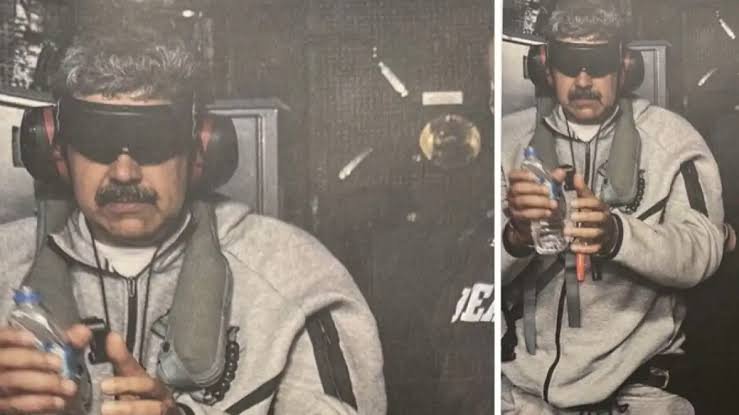
There was a time when removing a head of state from a sovereign nation required paperwork and tanks. Or, at the very least a declaration of war. Today, it appears one may simply vanish in broad daylight – in the name of global order.
Read on 👉 The Principle of Reciprocity: How Mali Redefined Power in Diplomacy
Somewhere in the world, a sitting president has been escorted out of his own country by foreign hands. Was he arrested? (that would imply jurisdiction.) He was not overthrown, because that would sound messy. Plus, the term overthrowing is only used in Africa, as I’ve mentioned already. Let us instead call it what officials prefer: a necessary act.
Man, It is the confidence for me. The confidence that one can lift a leader from a sovereign nation, relocate him across borders and expect applause. If not applause, then everyone should agree with you and stay silent.
History, of course, has seen this before.When a country decides its oil belongs to its people, suddenly its leader becomes unstable. When a nation toys with alternative currencies, its government grows dangerous. When independence stops being symbolic and starts being financial, concern arrives on schedule.
Sovereignty, it turns out, is a conditional privilege. It exists until it interferes with markets, minerals or monetary order. After that, it becomes optional. And that is when you begin to understand that sovereignty is a facade, and that none of us is truly ever free.
How can a president be removed from his country without a warrant recognised by his state, or even the decency of pretending it wasn’t extraordinary? Is this what they mean by progress?
Why bother with coups when one can perform a quiet extraction?
Why endure international debate when confidence will do? Looks like the future of regime change may be less noisy and more professional . Nothing to see here, apart from another sovereign nation learning how fragile sovereignty really is.