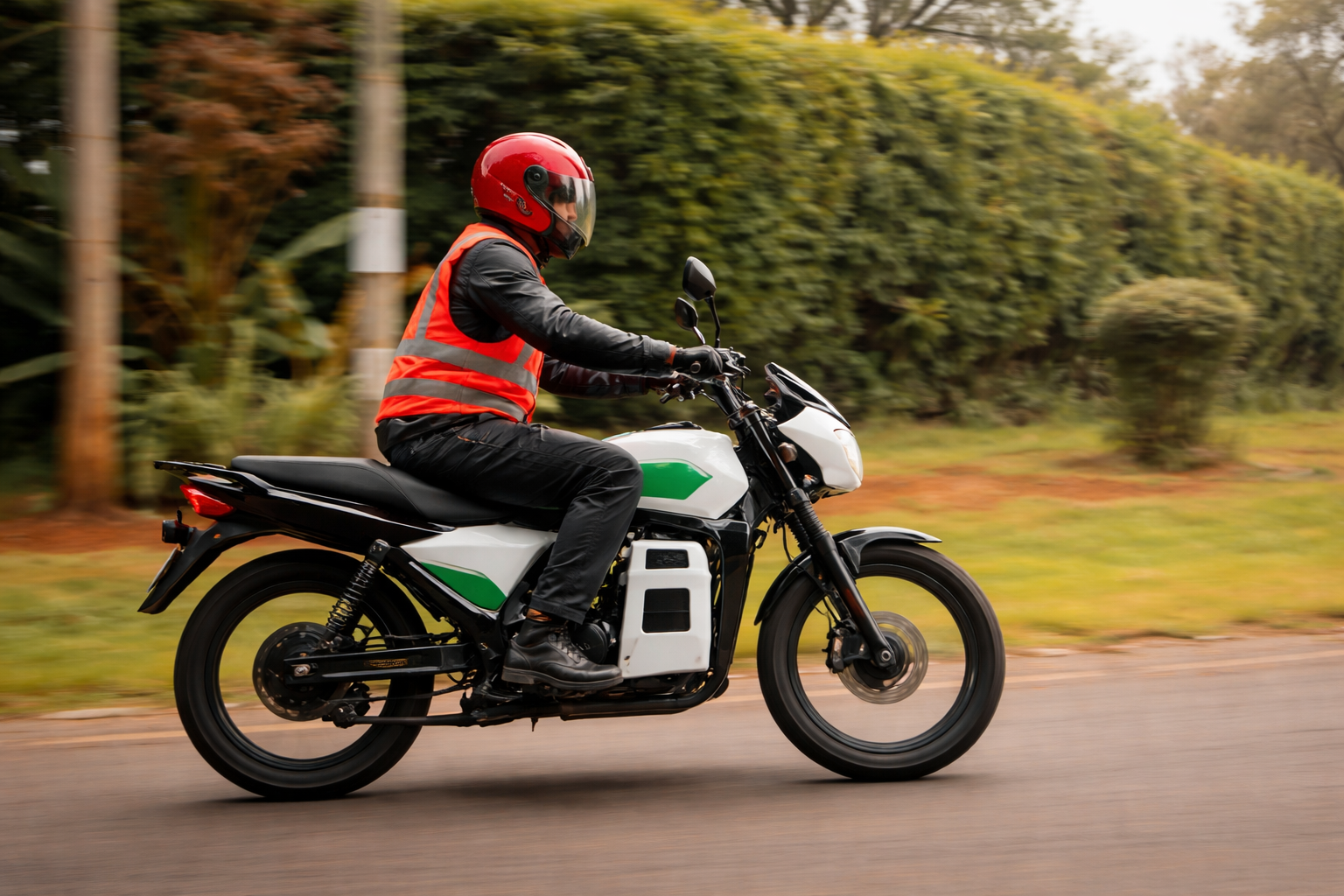
I recently had my first electric motorbike ride (I know, I know, I am a bit late to the party) and I have to admit that I was not prepared for how comfortable it would feel. There was no aggressive engine noise and even better, no vibrating seat beneath me. And let is not start on the familiar roar that usually defines movement through the city. Instead, there was a quiet glide through traffic that is surreal in a place like Nairobi where sound is part of the rhythm of everyday life. It felt smoother and in a strange way, more modern than anything I had experienced on two wheels before.
Somewhere along the ride curiosity got the better of me, and I asked the rider what it was like to actually own and operate one of these bikes. He laughed slightly and with a hint of pride and relief told me, “Hii ni different kabisa.” This one is completely different.
He explained that with his previous petrol motorbike, most of his daily earnings would quietly disappear into fuel. Every morning began with a calculation on how much to fuel, how much he needed to make and how much would remain at the end of the day. Now, with the electric bike, that pressure had eased. Charging was cheaper and more predictable. In his words, hii inasave pesa vibaya sana.
There was also less strain on the bike itself. Fewer mechanical issues hence less frequent servicing, and more time on the road actually working. As much as it was about comfort for the passenger; it was also about stability for the rider. A kind of financial breathing room that had not existed before. As he kept explaining it to me, it became clear that electric mobility is not just a futuristic concept but – for those who have access to it – quietly life changing.
The benefits are difficult to ignore. Lower running costs mean higher daily take home income. Reduced reliance on petrol shields riders from the constant fluctuations in fuel prices (see what is happening now with the Iran war). And beyond the economics, there is the environmental shift, however gradual it may seem. Less noise, fewer emissions and a step, however small, toward cleaner cities.
It is easy, standing in that reality to see why the transition to electric is being framed as inevitable. Why companies like Ampersand are expanding and conversations around clean transport are gaining urgency. And to be honest, this does feel like progress.
But as the ride continued, so did the conversation and with it came another truth. That Access to this “better way” is not automatic.
While his experience had improved, getting there had not been simple. The bike itself was not something he could have afforded outright. It required entering a financing arrangement, and taking on a level of risk that not every rider is in a position to take. For many others still operating petrol bikes across the city, that first step remains the hardest one to make.
This is where the promise of electric mobility begins to split into two realities. On one side are those who have managed to transition and are already experiencing the benefits ( earning more, operating within a more stable system). On the other side are those who remain where they have always been, aware of the change but unable to step into it.
Infrastructure only deepens this divide. Charging stations are still limited and where they exist, they are not always conveniently located for riders who rely on speed and efficiency to make a living. The shift from a quick fuel stop to a more structured charging process introduces new dependencies on location, on time and on availability. For some, this is manageable but for others it is a barrier.
Policy, too, remains in a space of slow emergence. While there is growing enthusiasm around sustainable transport, the frameworks needed to support widespread adoption (particularly among small scale operators) are still taking shape. Incentives exist in conversation, but are not always felt on the ground where decisions are made daily and survival is immediate.
And yet, the potential remains undeniable.
Electric mobility has the capacity to reshape not just how people move but how they earn, and save. This in turn makes it even easier for them to plan their lives. It offers a version of transport that is not only more efficient but more sustainable in every sense of the word, i.e. economically and environmentally.
But transitions, especially ones framed as progress, have a way of revealing existing inequalities rather than resolving them. They move fastest for those who already have access and slowest for those handling uncertainty without a safety net. This is where financial institutions have a role to play that goes beyond observation. If electric mobility is to become more than a promising niche, it will require deliberate efforts to make entry points more accessible, financing more flexible and systems more inclusive.
That quiet, smooth ride through the city was more than just a new experience. It was a glimpse into what is possible when innovation meets everyday life in a meaningful way. But it was also a reminder that possibility, on its own, is not the same as access. And as the electric transition continues to gather momentum, the question will remain not whether it is coming, but whether it is coming for everyone.