Kenya is no longer Africa’s most competitive economy, at least according to the latest IMD World Competitiveness Ranking. And yes, that sounds like bad news.
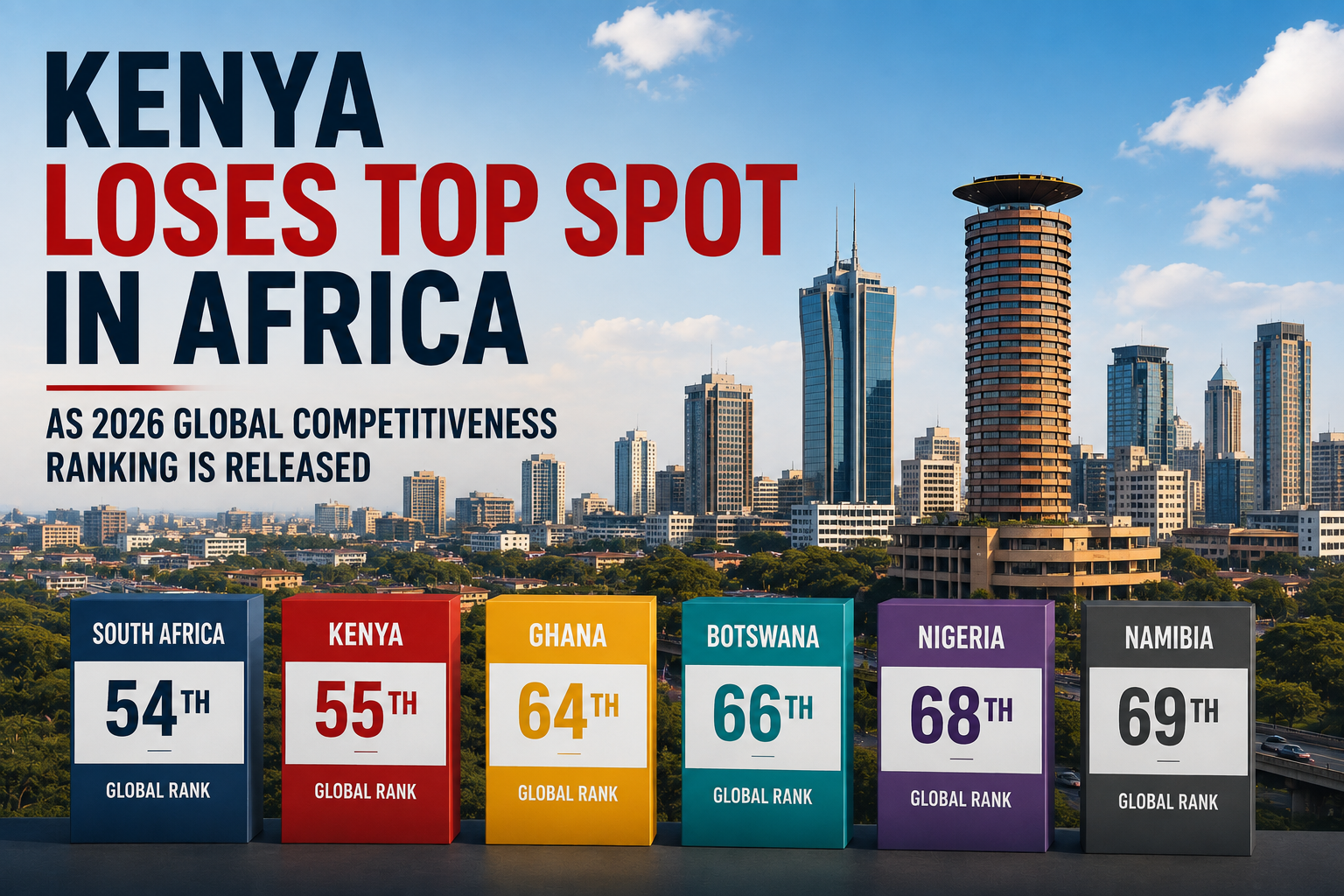
After taking the top spot among the African economies assessed in the 2025 ranking, Kenya has slipped to second place in 2026, with South Africa taking the continental crown after making a significant jump up the global rankings.
Well, how bad is it?
Kenya may have lost its first position, but it still ranks ahead of several of Africa’s biggest and most influential economies like Nigeria, which sits near the bottom of the 70 economies assessed globally.
The 2026 ranking by the Switzerland based International Institute for Management Development (IMD) places South Africa at 54th globally, Kenya at 55th, Ghana at 64th, Botswana at 66th, Nigeria at 68th, and Namibia at 69th.
Kenya Goes From First to Second
The change is particularly notable because Kenya was Africa’s best performing economy in the 2025 IMD World Competitiveness Ranking, where it was 37th globally, ahead of Botswana, Ghana, South Africa, Nigeria and Namibia among the African economies included in the assessment.
A year later, however, Kenya has dropped 18 places globally to 55th! At the same time, South Africa has gone in the opposite direction, climbing 10 places to 54th globally, allowing it to overtake Kenya and reclaim the position of Africa’s most competitive economy. Its overall score reached 50.16 points.
That makes Kenya’s second place position a little more complicated than the headline might suggest. While it is no longer leading Africa, it remains only one position behind South Africa globally.
And perhaps more importantly, Kenya is still performing considerably better overall than some economies that are often spoken about as Africa’s heavyweight economic powers.
Namibia, meanwhile, is quietly becoming one of the countries to watch on the continent. The country is attracting growing attention for its mineral wealth, strong uranium output and, increasingly, its enormous offshore oil and gas potential. With major oil discoveries, green hydrogen ambitions and new investment opportunities putting Namibia on the radar of global investors, its economic story is beginning to look very different from a few years ago.
Kenya Still Has Nigeria Looking Up
Will this make Kenyans feel a little better about the ranking? That Nigeria, Africa’s most populous country and one of the continent’s largest economies, has been placed 68th out of 70 economies in the 2026 competitiveness ranking.
Ghana is 64th, Botswana is 66th, while Namibia is 69th.
There is an interesting twist here, though. Nigeria actually performed better than its overall position might suggest when it comes to economic performance. It ranked 55th globally in that particular pillar, making it the best performing African economy in economic performance among the six countries assessed.
But competitiveness is about more than simply how large an economy is or how well it performs economically in one area.
The IMD ranking considers four broad areas: economic performance, government efficiency, business efficiency and infrastructure. Its methodology combines statistical data with the perceptions of business executives, with hard data accounting for two-thirds of the overall ranking.
That distinction is important because it explains how for example, Nigeria can lead the African group on one measure while still ranking 68th overall.
In other words, being a huge economy does not automatically make an economy easy, efficient or attractive to do business in. And that is where Kenya continues to hold its own.
What Is Pulling Kenya Down?
The ranking also gives us a useful reminder that competitiveness is not just about GDP, flashy infrastructure projects or how many multinational companies have offices in Nairobi. The IMD assesses economies across economic performance, government efficiency, business efficiency and infrastructure, looking at everything from the effectiveness of government policies to the environment in which businesses operate.
And in that sector Kenya perfoms really well, with its competitiveness also being tied to how well its infrastructure keeps pace with a rapidly changing economy. From e-commerce to last-mile logistics, businesses are increasingly relying on technology to solve everyday problems.
Therefore, the drop from 37th globally in 2025 to 55th in 2026 therefore deserves more attention than simply saying that South Africa has taken the top spot.
The country needs to ask what changed and perhaps even more importantly, what can be improved before the next ranking?
The broader 2026 IMD findings put particular emphasis on the importance of strong institutions, predictable rules, enforceable commitments and public trust in helping economies remain competitive in an increasingly uncertain global environment.
That is a conversation Kenya cannot afford to ignore.
A country can have a strong entrepreneurial culture, a sophisticated financial sector, a growing technology scene and one of East Africa’s most important commercial hubs, but competitiveness ultimately depends on whether the wider system works well enough for businesses and people to thrive.
To be honest, Kenya’s position as a regional economic and diplomatic hub is hardly new. Nairobi has spent years building a reputation that extends beyond Kenya’s borders, including its position as a major United Nations centre in Africa.
There is a temptation to look at the 2026 ranking and conclude that Kenya is going backwards but that would be too simplistic.
Yes, losing the number one position in Africa is significant. Kenya’s fall from 37th globally to 55th is also substantial and should raise questions about the country’s competitiveness. But Kenya remains Africa’s second-most competitive economy in the 2026 ranking, sitting just one place behind South Africa globally.
There is also an important caveat to the African rankings: the IMD World Competitiveness Ranking currently assesses only six African economies; Botswana, Ghana, Kenya, Namibia, Nigeria and South Africa. The organisation says expanding coverage across the continent is part of its ongoing efforts. So this isn’t a ranking of all 54 African countries.
For Kenya, then, perhaps the most useful way to read the 2026 results is not as a funeral for its competitiveness crown, but as a warning shot.