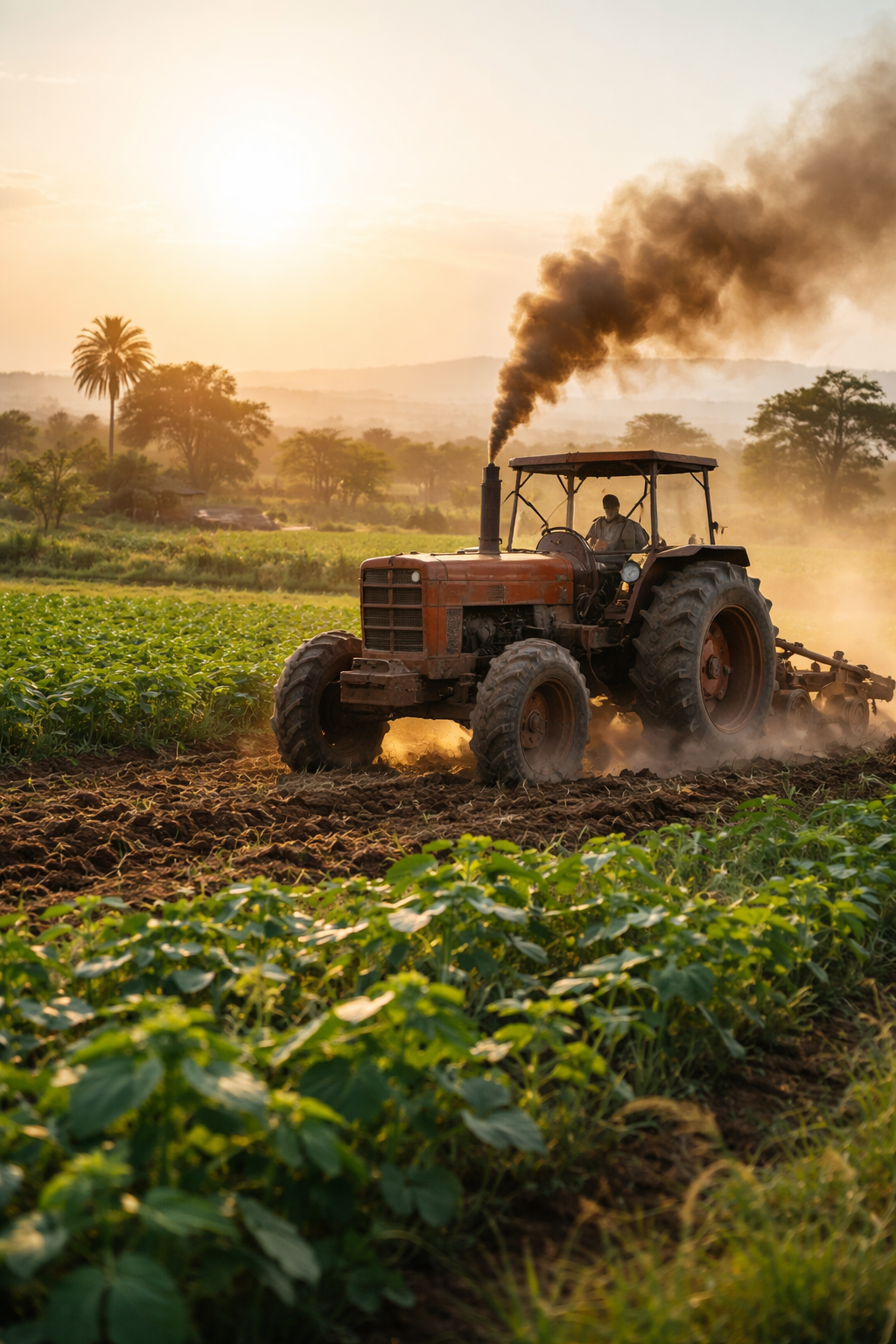
For a continent that is richly fertile and deeply rooted in agriculture, Africa should be leading from the front in this quiet revolution. Its economies are still closely tied to the land and its people remain connected to farming not as an industry but as a way of life. Plus its conditions – abundant sunlight, expanding rural electrification and a growing need for efficiency – make it uniquely positioned to embrace a new kind of agricultural future. And yet, the shift is only just beginning to take shape.
For decades, the soundscape of farming has been defined by diesel engines. The tractor as we know it, heavy and unyielding, has stood as a symbol of endurance and productivity as its mechanical rhythm echoes across fields. That familiar and enduring image is now beginning to change (hopefully) in a gradual, almost unnoticeable transition. And at the center of it all is the electric tractor.
Much of the global conversation around clean energy continues to orbit urban life, where electric vehicles glide through city streets and solar panels line suburban rooftops. Meanwhile people conveniently forget about agriculture, despite it being one of the most energy intensive sectors in the world. Farming has always depended on power whether for ploughing, irrigation, harvesting or transport. For generations, that power has been overwhelmingly tied to diesel, creating a system that is both costly and vulnerable. This is where electric tractors come in, challenging this dependency in a way that goes beyond substitution. They introduce the possibility of redesigning how farms consume and manage energy, shifting from a model of reliance to one of autonomy.
From Fuel Dependence to Energy Independence
As we are currently witnessing, the economics of diesel are becoming increasingly difficult to ignore. Fuel prices fluctuate, supply chains remain fragile and rural access is often inconsistent. For many farmers and especially those operating at smaller scales, this unpredictability becomes a real vulnerability. Electric tractors offer an alternative that is as much about stability as it is about sustainability. When paired with solar systems or localized mini grids, they allow farms to generate and control their own energy. The tractor is no longer dependent on external supply networks but becomes part of an internal ecosystem, drawing power from a source that is both renewable and, in many parts of Africa, abundant.
Once this happens sustainability then becomes something practical and immediate rather than abstract. It is not only about reducing emissions but also lowering long term costs and placing control back into the hands of the farmer, whose biggest priority is cutting costs and avoiding inconvinience.
A Cleaner Machine yes, But That’s Not the Real Story
It is easy to focus on the environmental benefits of electric tractors because of how significant they are. Reduced emissions, lower noise levels and alignment with global climate goals all contribute to their appeal. However, to stop there would be to miss the deeper transformation taking place.
What distinguishes electric tractors is not simply that they are cleaner, but that they are fundamentally different in how they operate. They represent a shift from purely mechanical systems to digitally enabled ones, opening the door to a new kind of farming that is more efficient and increasingly data driven.
Simply put, the tractor is becoming a computer.
Diesel tractors belong to an era defined by mechanics while electric tractors belong to one shaped by software. A distinction that is by every definition, structural. Electric systems integrate more naturally with technologies such as GPS guided precision farming, sensor networks and real time monitoring tools. They can track energy usage, optimize performance and adapt to varying conditions with a level of responsiveness that traditional machines cannot easily match.
As these capabilities expand, the tractor begins to evolve from a standalone machine into part of a broader digital ecosystem. It becomes a node in a network of devices and data streams that together redefine how farming decisions are made. In this context, power is no longer measured only in horsepower, but also in intelligence.
The Battery Problem and Why It Won’t Last Forever
Despite this momentum, one challenge continues to shape the pace of adoption: battery capacity. Diesel tractors have long set the standard for endurance, capable of operating for extended hours with minimal interruption. That has always been there strongpoint. Electric tractors on the other hand are still constrained by the limits of current battery technology.
At present, they are best suited to smaller farms, shorter tasks and operations that can be carefully managed within defined timeframes. For large scale, continuous use, diesel retains a practical advantage. Yet this limitation is not static. Advances in battery technology are steadily improving energy density and lifespan. Innovations such as solid state batteries and alternative charging models are already beginning to shift what is possible. Concepts like swappable batteries and solar integrated charging infrastructure suggest that the current constraints may be temporary rather than permanent.
The Invisible Revolution: Power Electronics
Beneath the visible components of electric tractors lies a less obvious but equally important layer of innovation. Power electronics and semiconductor technologies are playing a critical role in making these machines viable.
These systems govern how energy is converted, distributed and used within the tractor. Improvements in thermal management and control systems have made it possible to extract more performance from each unit of stored energy. In many ways, these unseen advancements are what allow electric tractors to compete at all. They form the quiet backbone of the transition, enabling the shift from mechanical dependence to intelligent energy management.
Read on —> 7 Things Our African Forefathers Did Perfectly Before Modern life ruined them
Policy vs Habit: The Fight Against Diesel
Across different regions, governments are beginning to support this transition through incentives, subsidies and investments in infrastructure. Rural electrification projects in particular are creating the conditions necessary for electric farming technologies to take root.
However, policy alone cannot displace decades of habit. Diesel remains dominant not only because of its capabilities but because of its familiarity. Farmers understand and trust it, and have built entire systems around it. Electric tractors require a different approach, one that involves higher upfront costs, new forms of infrastructure and a willingness to engage with digital systems. These are not insignificant shifts and they help explain why adoption is gradual rather than immediate.
Change, in this context, is as much cultural as it is technological.
Africa’s Opportunity to Leapfrog
It is precisely within this gradual transition that Africa’s opportunity becomes most visible. The continent’s agricultural foundation combined with its expanding access to renewable energy creates the conditions for a different kind of adoption curve.
Rather than replicating the fuel dependent models of more industrialized regions, there is potential to move directly toward integrated, renewable powered farming systems that would not only reduce long term costs but also insulate farmers from the volatility of global fuel markets. For smallholder farmers who form the backbone of African agriculture, the implications are particularly significant. Greater control over energy translates into greater control over productivity, costs and ultimately, livelihoods.
The barrier – so it would seem – then becomes access, financing and infrastructure. These will determine how quickly this potential can be realized.
In conclusion, electric tractors are unlikely to replace diesel in a single, sweeping transition. The shift will unfold incrementally, shaped by improvements in technology, changes in policy and evolving economic realities. Each year as batteries become more efficient, as systems become more affordable and as awareness grows, the balance will continue to tilt. What feels experimental today will begin to feel practical and eventually, inevitable.
Read on –> Why Kenya Should Legalize Commercial Marijuana Farming