As of today, wednesday, June 11, 2025 – exactly two weeks to the historic June 25, 2024 – I am a very proud Kenyan.
Not the kind of pride that waves a flag only on national holidays or during a football match but the kind that swells in your chest when you see the courage of ordinary people doing extraordinary things. We are a nation of brilliance and radical hope, even though we don’t fully realize it. Maybe we do realise it or are simply becoming more aware, but i don’t think we fully grasp the extent of how radically hopeful we are. I swear kenyans inspire me every single day because of what we keep doing in spite of what we lack.
I saw this firsthand on June 25, 2024, on that fateful day during the march to Parliament.
The air was thick with smoke and defiance. Somewhere between Haile Selassie and Kenyatta Avenue, a mixture of bullets, teargas canisters and water kannons began tearing through the crowd. But no one scattered. If anything the crowd kept surging forward. A sea of bodies with the only common thing being their pounding hearts; hearts pounding with fear and determination. Young people fell. I was there and saw it with my own eyes. Shot. Carried. Covered with Kenyan flags. Their friends were there but didn’t run. They wiped blood from their hands and kept marching toward the sound of gunfire. I will never forget those scenes.
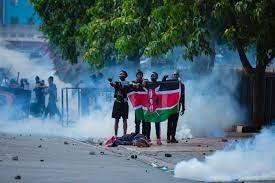
young Kenyans standing over the body of their fallen comrade, amidst teargas smoke and police in the background
Then it happened. The coordination was insane and nothing like I had ever expected.
“We are in!”
That raw cry was defiant and victorious as it echoed through the crowd as the first wave of protesters broke through and stormed into Parliament. From this point onwards it was war and a game of luck and chance. Chances are, you could be among the people who would not live to tell the tale. This was history tearing through steel gates and riot shields. For once, we weren’t just pushing back. We were breaking through.
If you want to know what patriotism looks like in Kenya, it’s not in speeches. Infact, those grandeur speeches by the kasmauels’ of this world are just that- speeches. Patriotism is in the silence after a gunshot and the rush toward the barricades, even as bullets fly all around them.
I will never forget that morning when I left my daughter with my neighbour and took a matatu to town, knowing at the back of my mind that the worst could happen. I will never forget the voice of anguish on the phone as my mom begged me not to go, the incessant calling from my siblings after every 30 minutes to check if i am okay and all the estate kids running towards me when i came back, hugging me and asking me how the “maandambando” were and if it is true people actually died. (these were 5-8 year olds). Most importantly, i will never forget the sombre mood in that matatu that morning, where everyone was dressed in black and we all knew even though no one dared to voice it out loud.
Who Was Albert Ojwang?
Albert Ojwang was not a threat to national security. He was not a terrorist or a thug, or a criminal, or any of the lazy names the state likes to slap on people it wants to erase. He was a young Kenyan with a phone, a voice – and the courage to use both.
Albert came from Homa Bay and was a digital warrior. He was a blogger; a sharp political critic with a brain like a blade and a keyboard that cut deep. He was a brilliant mind that spoke truth with that dangerous combination of intelligence and audacity that this country loves to hate in its young people. Because Albert didn’t wait for permission to speak, that made him a target.
Albert was neither famous nor protected. What he believed in was calling out the rot and saying the kind of things that scare politicians and embarrass police bosses. And he believed that silence in the face of injustice is complicity.
And so they silenced him.
An only child dead at 24. And for what really…..words?
They thought they were killing a nuisance. What they did was ignite a movement.
Albert Ojwang was not a martyr when he died. He was just a young man trying to live honestly in a dishonest system. But in death, he became something the state will (hopefully) regret for a long time. He became a symbol.
The people responsible for the death of Albert Ojwang were sure they’d get away with it, probably thinking he’s a nobody. Kumbe in this era of social media, everybody is somebody.— Dr. King’ori (Shaman) (@Dr_Kingori) June 10, 2025
Here is the thing; if they can kill Albert for tweeting, they can kill any of us. And if we don’t rage for him now, we’re handing them permission to make him just another hashtag.
The Arrest & Death….. What Happened to Albert Ojwang?
The story of Albert Ojwang’s death doesn’t begin in a jail cell. It begins with fear. And I do not mean his fear, but theirs.
Fear of a voice too sharp and a mind too clear. Fear of a young man who refused to be silenced….so they came for him.
Albert was arrested around June 6, 2025. Officially, they claimed it was over “cybercrime.” He was taken from Homa Bay, over 400 kilometers away, to Nairobi without explanation, legal support and zero rights respected. If we are being honest, that’s a kidnapping with paperwork.
Then, on June 8, the news dropped that Albert Ojwang was dead. The official story they gave was that he “hit his head” on the wall of his cell. I do not know if it is funny or sad that they actually think we would believe that a young, healthy man somehow killed himself by accident in a locked room under police watch – by knocking his head on the wall.
But the truth doesn’t lie and it always comes out one way or the other. The postmortem spoke louder than any press release: head trauma, neck compression and Signs of torture.

And still, no one has been arrested or even confessed. No one has stood before the nation to answer for what was done in that dark room. Because in Kenya, death in police custody is not a scandal. It’s a system. It is business as usual. As it was with Rex and everyone else that has fallen under the hands of rogue officers.
What happened to Albert Ojwang was a brutal reminder that when you speak too loudly, the state will do what it has always done best – erase.
The Generation They Didn’t See Coming
Albert Ojwang wasn’t just a victim of police brutality. He was part of something much bigger that looks like it came out of nowhere – a generation that’s rewriting the rules of African resistance. So sudden was their courage actually, that even the leaders do not know what to do with them, with their own president going ahead to call them “organised criminals”.
This is a smart, fearless, digitally connected, politically awake generation – and angry. Angry because they were born into broken systems and raised on empty promises. But the thing is, kenyan genz are not even about just kenya anymore. They have crossed borders and now Africa is watching them.
When Kenya’s youth flooded the streets in June 2024 and forced their way into Parliament, the internet on all african platforms exploded. They inspired many young people across the continent who started something similar of their own. Even in the April 30th protests where people worldwide were protesting on behalf of Ibrahim Traoré’s and Burkina faso, many Africans across the continent looked up to the Kenyan youth to lead the way.
In Nairobi, that same fire is burning. But here, it’s not guns fueling it. Rather, it’s grief. Grief over the death of Albert and the many lost futures.
The World Is Speaking but Is the Government Listening?
As the streets continue to rumble, statements are flying from all directions including bloggers, activists and surprisingly, even from inside the system.
Finally, fools can stop referring to Albert’s death as “mysterious, suicide etc etc” Albert Ojwang was Murdered. A truth we all knew but cowards refused to call it for what it is!! Now, we will fight for justice and leave no stone unturned pic.twitter.com/SUt5C8CS52— Lynn Ngugi (@lynn_ngugi1) June 10, 2025
Albert Ojwang, a Kenyan blogger who died in police custody, was hit on the head and his death was likely to have been caused by assault, a post-mortem has revealed. The results of the exam contradict a previous version told by the police. https://t.co/80n5dFXxMv pic.twitter.com/VtGQWhhXAS— BBC News Africa (@BBCAfrica) June 11, 2025
I was teaching writing condolences today just in time to use my friend and colleague Albert Ojwang as an example. I hope his soul never rests till all his murderers have paid for what they did to wuod Migori #JusticeForAlbertOjwang pic.twitter.com/SrvMJGswlR— Josh (@Josh001J) June 10, 2025
”I am here because Albert Ojwang cannot stand to testify in court”- A Kenyan lady lectures the state! pic.twitter.com/nGcJE8bB69— The Kenyan Vigilante (@KenyanSays) June 10, 2025
As DIG Eliud Langat types his RESIGNATION statement, the guy who wrote and published the statement indicating that Albert Ojwang banged his head on the wall should be FIRED & JAILED.— CPA Mwangi Ng’ang’a (@Mshomolozi) June 10, 2025
Even famous kenyan rapper has a new song adressing what is currently going on in the country. Check it out here —https://www.youtube.com/embed/zok_0ef7h2w?si=1-FYKqQS0-DM3tEv
Albert Ojwang is not just another statistic. Not to us.
He was someone’s (only) son. And they killed him for what exactly?
Counterproductive if you ask me because in trying to silence him they have multiplied his voice. Now every tweet demanding justice carries his voice and every protest sign carries his spirit.
And even though hashtags fade, in the hearts of young Kenyans, something permanent has shifted.
Kenyans are not begging for justice, they are loudly demanding for it. You understand eh, that asking has never worked in a country where peaceful protests are met with bullets and autopsies are contested but never prosecuted.
We want arrests, resignations and full public accountability from the Interior Ministry and every desk that signed off on Albert’s death.
Why do the people in power forget about how fleeting power is? Where is Moi and his cronies Mobutu ssese seko and Idi Amin Dada? Heck, what happened to Hitler in the end? Remember the French revolution, anyone? Haven’t they realised by now that for every young Kenyan they kill, two others come up in their wake? How hard is it to actually do the right thing, cut on corruption as opposed to trying to silence everyone? Because the youth of Kenya have nothing to lose and that makes them the most dangerous generation this country has ever tried to silence.