In a country where global sporting glory is almost always associated with long distance runners, football heartbreaks (these have been countless, year after year) and the occasional rugby high, it is deeply refreshing to celebrate a Kenyan sporting win that comes from an entirely unexpected place. Not a track or a pitch, but a darts board in London. David Munyua’s historic victory at the Professional Darts Corporation World Darts Championship has done more than put Kenya on a new sporting map. Like Yego’s win did all those years ago, and Angela’s doubles win in Wimbledon a couple of years ago, it has reminded us that excellence can emerge far beyond the disciplines we have grown used to exporting to the world.
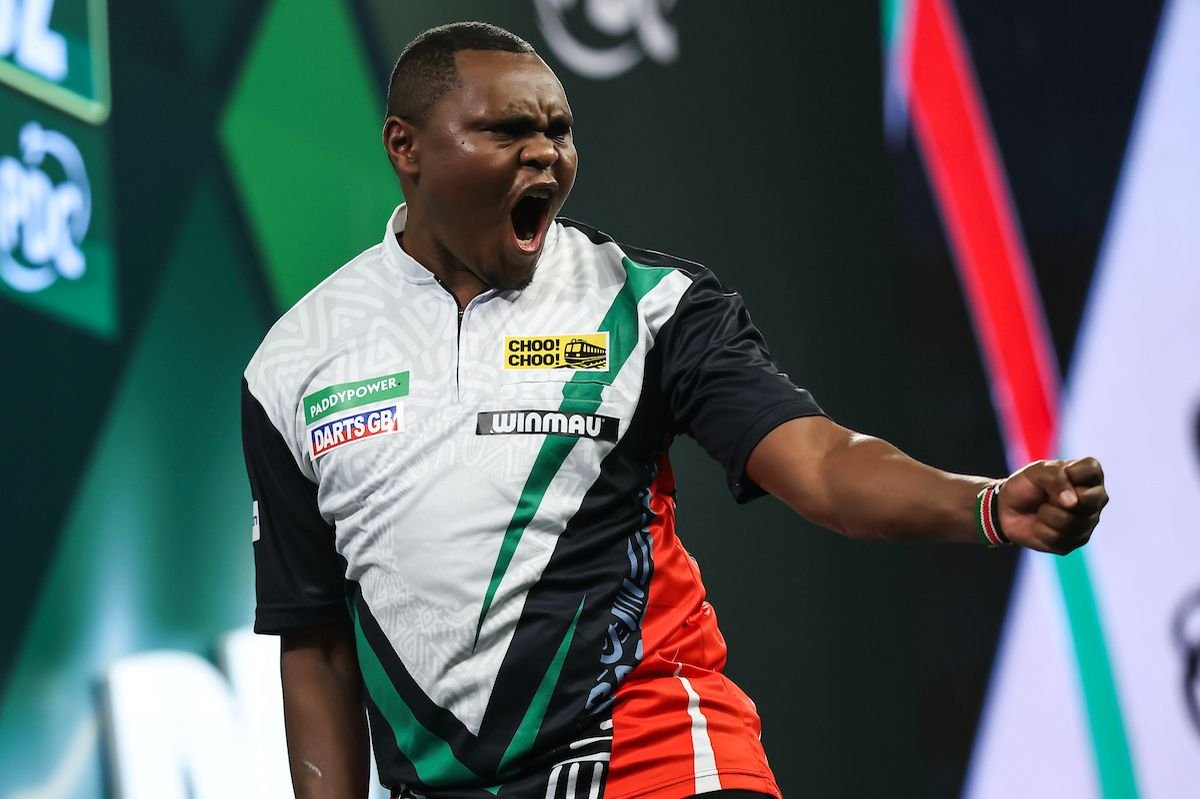
Munyua has just become the first Kenyan to win a match at the PDC World Darts Championship, the sport’s most prestigious global stage, held at Alexandra Palace. In doing so, he not only represented Kenya, but Africa at large, carrying with him the hopes of a continent that rarely features in elite darts competition. His achievement feels particularly striking because it disrupts long held assumptions about what Kenyan sporting success is supposed to look like.
The journey to that moment was anything but predictable. Munyua qualified for the championship after winning the African Darts Group Qualifier, defeating South Africa’s Cameron Carolissen to earn his place among the world’s best. For a player who had never travelled outside Africa before this tournament, the step up was enormous. The crowd was louder, and as is expected with the terrain, the pressure unforgiving.
Yet it was on his World Championship debut that Munyua truly announced himself. Yes, it was his world champion debut. And yes, he came in as the underdog. Facing Belgium’s Mike De Decker, a world number 18 and former major champion, our Kenyan found himself two sets down. For many debutants, that would have been the end of the story. Instead, Munyua mounted a stunning comeback, winning three straight sets to claim a 3–2 victory that instantly became one of the tournament’s most talked about upsets.
The match itself had moments that felt almost symbolic. At one point, a wasp landed on Munyua’s face mid play, briefly halting the action and drawing gasps and laughter from the crowd. The incident only added to the surreal nature of the night, as if to underline just how unlikely and human this story was. Munyua remained composed and unshaken. Composed and unshaken are indeed, the qualities that would define his performance throughout the match.
Away from the spotlight, Munyua’s life is far removed from the glamour of professional sport. Back home in Kenya, he works as a full time veterinarian, balancing his career with his passion for darts. His trip to London was made possible through sponsorship and public support, highlighting how under resourced and under recognized darts remains within the country. (Although if we are being honest, which sport can claim full support? There is always this or that going on.)
That reality makes his achievement even more remarkable.
The significance of his win was quickly acknowledged at home. Messages of congratulations poured in, including public praise from President William Ruto, who celebrated Munyua’s achievement as a moment of national pride. For many Kenyans watching from afar, the victory carried a sense of collective joy. It is that feeling of seeing one of our own succeed in a space where we are rarely represented. Admittedly, this is happening more and more, as seen recently with our very own tech guy, John Tingoi.
Beyond the immediate headlines, Munyua’s success challenges the narrow framing of Kenyan athletic identity and opens the door for young people who may not see themselves in traditional sporting pathways. His story suggests that with talent and support, Kenyans can compete (and win) in arenas far beyond those we have historically dominated.
In that sense, David Munyua’s darts victory is not just a sporting upset. It is a cultural moment, a reminder that Kenyan excellence is more expansive than we often allow ourselves to imagine.
In Kipchoge’s now famous words, No Human Is Limited.