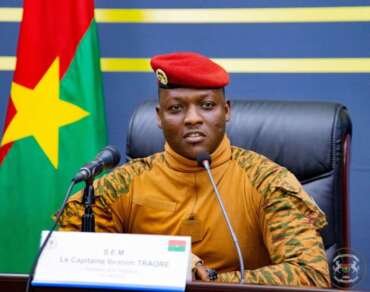
In a world where most presidents wear suits and say a whole lot of nothing, Captain Ibrahim Traoré walked in with a military jacket, a fierce stance and the unapologetic energy of a man who’s read too much Sankara to play nice with colonizers.

“We will mine our gold reserves ourselves and not for France, but for our people.” traore – 2025
Only last year, president Ibrahim reduced ministers and all politicians salaries by 30% and increased workers salaries by 50%. At just 35, the President of Burkina Faso has done what most African leaders would only dare to dream of – kicking out the west. French troops? Chased away. No more foreign meddling, not in his watch anyway. And with that single move, Traoré lit a fire under a generation of Africans tired of external control disguised as “partnership.”
These are interesting times, now more than ever, young africans are beginning to get involved with african politics. They are eager to understand why a continent that is super rich in resources and minerals, happens to be one of the poorest in the world. They scratch their heads over news stating that France has some of the highest gold reserves, while it doesn’t even produce gold. These young people are bitter that those before them sat back and did nothing while Gaddafi was hunted down like a dog and killed by the same western powers that are now after ibrahim. And as April 30th approaches, young people across the continent are gearing up to protest outside American and French embassies. From Nairobi to Lagos, Accra to South Africa, the message is clear: Africa is not your playground anymore.
But how did a young soldier from Burkina Faso become the face of this modern-day liberation movement? And why is the West suddenly acting like he’s the villain?
The rise of Africa’s most unexpected revolutionary icon.
From the moment Captain Ibrahim Traoré seized power in 2022, Western governments have been shifting uncomfortably in their diplomatic seats, smiling to his face but plotting on how to get rid of him behind his back. And now, the attempts aren’t even subtle anymore. The guy has had numerous assasination attempts (more than 18) since he got in power. After all, it’s not every day that a young, battle-ready African leader tells France to pack up their military bases and leave. Interestingly, he doesn’t waste time with press conferences or long-winded diplomacy – just action.
The script is one we have seen playing out over and over before. Western media quickly sprang into motion with their usual script: “military junta,” “destabilizing force,” “pro-Russian leanings.” Headlines painted Traoré as reckless, anti-democratic and a threat to stability. But stability for whom, exactly? The multinationals mining African resources or the actual people of Burkina Faso?
All these accusations do not seem to be working, so they’ve pulled out an old classic: accusations of gold siphoning. Western outlets and think tanks have started suggesting that Traoré is diverting Burkina Faso’s gold for personal gain instead of the nation’s. But here’s what they conveniently leave out: he cut off Western access to the country’s mineral wealth. Let’s say for instance, that he actually was stealing the country’s gold. So you want to tell me the French are good enough for stealing, but not the country’s own son? And if he is, what business of theirs is it that they now even want to eliminate him? It truly is the hypocrisy for me.
The truth is, Burkina Faso under Traoré, has been working to reclaim its resources and manage them in ways that benefit its people; not just foreign investors and billion-dollar corporations. By shutting down sweetheart deals and resource extraction without fair compensation, he has stepped on powerful toes. Crazy if you ask me that the same voices that applauded decades of plundering are suddenly concerned about “transparency.”
What’s really annoying the west? Is it the fact he didn’t go to Davos, that he went straight to work? Or the fact that he didn’t hold a summit on foreign influence but removed it – without asking for permission?!
April 30th – The Protest Heard Across the Continent
On April 30th, thousands of young Africans are expected to take to the streets in cities across the continent. From Nairobi to Dakar, from Johannesburg to Kinshasa to Lagos, they’ll be marching toward French and American embassies not just to protest, but to make a declaration that it will no longer be business as usual in Africa.
However, If you go through the numerous tweets and tiktoks, you will realise that this is more than a response to modern politics. This is a reckoning centuries in the making. Behind every step of this protest is the ghost of King Leopold II of Belgium, a man whose name still sends a chill through Congo’s history. Under the guise of “civilizing” Africans, Leopold’s forces mutilated, enslaved and massacred millions of Congolese people. Hands were chopped off for not collecting enough rubber. Villages were burned to the ground with Families being destroyed…and for what really? Profit was the end goal, while Europe watched in silence, sipping tea and looking the other way.
Fast forward to the so-called independence era. We all know the atrocities didn’t stop, they just got slicker. Leaders like Mobutu Sese Seko were backed by Western powers because they played ball and not because they protected their people. Mobutu, a leader that ruled Zaire (now the DRC) like it was his personal inheritance, pocketing billions while his people starved. Over a decade in power, he didn’t even build a single road in the whole country, instead building a personal airport to his palace in the jungle. Guess who funded the airport? The same Western powers are now clutching their pearls over Traoré’s patriotism.
Whenever a real African leader rises, one with vision, backbone and a dream for the continent, he doesn’t last long. Patrice Lumumba, Congo’s first elected Prime Minister was assassinated with the blessing of Western intelligence because he dared to seek economic independence. Thomas Sankara, the revolutionary Burkinabé president who refused foreign aid and told African countries to produce what they consume, was murdered in a coup many believe France helped orchestrate. Colonel Muammar Gaddafi, despite his flaws, was building a pan-African banking system and trying to unify Africa under one currency – only to be taken out in a NATO-led bloodbath.
According to this X user “They killed Gaddafi now they want to kill Captain Ibrahim Traore, WE The People will not allow.” https://x.com/NewbieFransisco/status/1914363233177362901
So when today’s youth raise their voices on April 30th, they are not being irrational or rebellious. They are responding to centuries of murder, manipulation and economic sabotage. Only that this time they are more unified and are determined to shed off the tag of a people known to do nothing as their leaders get assassinated – this time round they are determined not to let the flame go out.
And perhaps the words of an old African proverb says it best:
“Until the lion learns to write, every story will glorify the hunter.”
Well, on April 30th, the lions are writing.
What This Means for Africa’s Future
The April 30th protests are more than just symbolic; they are a start to what could be a turning point. A declaration that Africa is no longer a passive observer of its own destiny, nor is it content to be an exploited supplier of raw materials for Western industries. The era of the “resource curse” is being rewritten.
For too long, the narrative of Africa has been crafted by foreign powers who have profited from its tragedies while undermining its sovereignty. But with leaders like Ibrahim Traoré and with the young generation rising to their feet, the tide is shifting. Across the continent, from the Saharan deserts to the southern tip, young Africans are reclaiming their agency. They’re rejecting the blueprint that was handed to them, one of dependency, corruption, and poverty and sketching out a new one, founded on self-determination, innovation and justice. In short, we are tired.
April 30th isn’t just about Traore; it is about demanding a future where Africa controls its own resources, writes its own history and forms its own alliances. Enough with the forced alliances and the arm twisting. Young gen z no longer want to be the children of a continent that is always in the shadows, always playing catch-up with the West.
April 30th is about building, too. It’s about reclaiming the narrative of unity that our ancestors fought for. From Kwame Nkrumah and Julius Nyerere, to Thomas Sankara and Nelson Mandela, Africa has always had its visionaries, but too often they were silenced. This new wave of activism is different. It’s digital, it’s viral, and it’s speaking louder than ever.
Now, the big question remains: Will this momentum build into something more sustainable, or will it fizzle like so many revolutions before it? The answer lies not just in the streets but in the leadership that follows. The challenge is for young Africans to remain focused, resilient, and to push for real change in the systems of governance, education and infrastructure that will ensure they don’t fall into the trap of repeating the mistakes of the past. They will need to demand transparency, fight corruption and ensure that Africa’s resources are used to lift the continent as a whole, not just a few elite individuals.
If Ibrahim Traoré’s rise is any indication, the West may not be able to control Africa’s story much longer.
As one protestor from Lagos declares, “The revolution is now. We are not waiting for the future. We are the future.”