In a continent that has almost every mineral and raw material imaginable, there is something very frustrating about Africa’s economic story. For decades, much of the continent’s wealth has been dug out of the ground or harvested from its soil and shipped elsewhere for processing, only to be sold back to Africans as a finished product at a price that is often ridiculously higher.
Africa exports cocoa and imports chocolate. It exports crude oil and, in many cases, imports refined petroleum products. It exports cotton and imports clothing. It exports minerals that are essential to modern technology and then imports the finished products built from them. We have the raw materials, the labour and, increasingly, the young people who could drive the industries, yet we continue to occupy the least profitable end of the value chain.
And it is difficult not to wonder how much of this is a failure of leadership.
Look at the Democratic Republic of Congo, a country sitting on extraordinary mineral wealth, yet one that has spent decades trapped in cycles of conflict and instability. Year after year, ordinary Congolese people are asked to live with violence, displacement and poverty in a country whose natural resources are worth fortunes to the rest of the world.
Then look at Nigeria, Africa’s largest economy and one of the world’s major oil producers, with a huge population of entrepreneurial and remarkably industrious people. Yet millions of Nigerians continue to live in poverty while the country struggles with the consequences of an economy that has for too long depended heavily on exporting crude rather than capturing enough value from it at home.
The examples go on and on.
And this is where the frustration becomes difficult to ignore. Across much of Africa, ordinary people have watched political elites become extraordinarily wealthy while public services remain inadequate, opportunities remain scarce and the burden of failed systems is repeatedly pushed onto the taxpayer. Too many leaders have appeared far more interested in enriching themselves and surrounding themselves with loyal cronies than in building economies capable of giving their citizens a better future.
For a young African watching all of this unfold, the never ending, frustuating question becomes, How can a continent this rich continue to be this poor?
It is against that backdrop that Ibrahim Traoré’s popularity begins to make a little more sense.
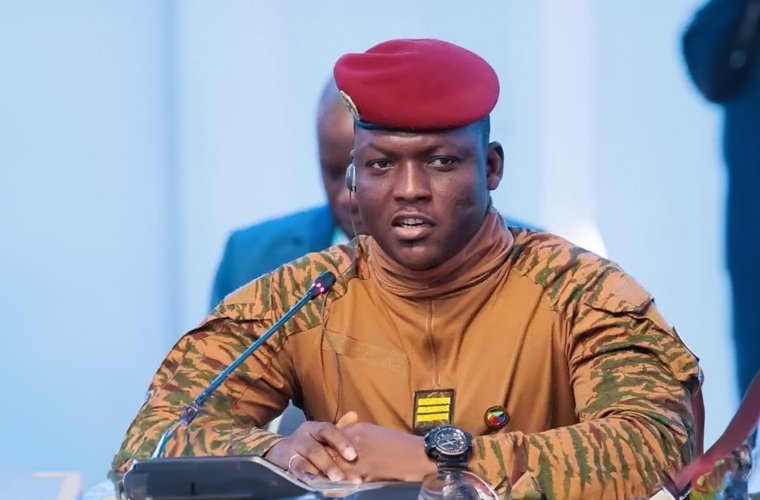
The young Burkinabè military leader is not merely being followed as a president, or even as a military ruler. To many young Africans watching from Kenya, Nigeria, Ghana, South Africa and elsewhere, Traoré has become a symbol of something they desperately want to believe is still possible: an African leader who is willing to stand up and say that African countries should control more of what they produce, process more of their own resources and stop behaving as though development must always begin with somebody else’s permission (which, as we all know, comes with a lot of disrespect.)
That is a powerful message on a continent where political frustration is running deep.
Perhaps it is not really about Traoré
The easiest way to understand Traoré’s popularity is to assume that millions of young Africans have suddenly developed an admiration for military rule. But I don’t think that is the whole story.
For many of his supporters outside Burkina Faso, Traoré represents an idea more than a government. He represents sovereignty, self reliance and the possibility that African countries could finally begin to negotiate with the rest of the world from a position of strength rather than permanent dependency.
You can disagree with Traoré’s politics, question his record or be highly uncomfortable with military governments and still understand why his message resonates.
Young Africans have grown up watching countries with enormous natural wealth struggle with unemployment, poverty, expensive imports, weak currencies and inadequate public services. They have watched politicians campaign with promises of transformation, only to see many of the same economic arrangements continue year after year.
They have seen their leaders been hauled in buses in western nations like school going children because let us be honest, how do you expect others to respect you when you don’t even respect yourselves – or your people for that matter. African leaders forget that the whole world is watching them, and that all their thievery actions are visible to everyone else.
Young educated Africans are tired of being told that Africa is rich in resources while ordinary Africans remain poor. And they are particularly tired of leaders who appear more interested in maintaining political power than changing the systems that keep their people dependent.
The raw material problem
This is where Traoré’s rhetoric becomes particularly attractive. One of the ideas associated with his government is that Burkina Faso should extract greater value from what it produces instead of simply exporting raw materials. The country has pushed local processing and industrialisation, including investments in agricultural processing and greater state involvement in strategic sectors.
That may sound like basic economics, but in much of Africa (the continent whose leaders do absolutely nothing but steal ALL THE TIME) it is politically significant.
Imagine what happens when a country stops asking only, “How much can we get for exporting this?” and starts asking, “What can we manufacture with this ourselves?” That is the shift many Africans want to see.
The difference between exporting a raw product and exporting a finished product is not simply the price on the invoice. It is the factories that have to be built, the engineers who have to be employed, the technicians who have to be trained, the logistics networks that have to be developed and the businesses that grow around the entire process.
It is jobs and skills. It is technology. It is tax revenue and industrial knowledge. Most importantly, it is ownership of the value chain. That is how much Africa is missing out on when they fail to process their raw materials. That means hundreds of industries being built elsewhere, which converts to thousands of jobs being created elsewhere. When you look at it that way, you begin to realize why this is important than just “stop exporting raw materials.”
For a young African struggling to find work in an economy that exports billions of dollars’ worth of natural resources every year, that idea is enormously appealing.
And then there is the question of courage
Traoré’s supporters also see something they believe has been missing from African leadership for a very long time: confrontation.
He has openly challenged France’s influence in Burkina Faso, pushed for greater relations with Russia and repeatedly spoken about African sovereignty and self reliance. His government has also taken a much more assertive position over the country’s natural resources.
Whether every policy will work is another question entirely, but politically, the symbolism is difficult to miss.
Traoré appears willing to say things that many African leaders avoid saying publicly (andddd we all know why.)
That matters to a generation that has grown increasingly cynical about politics. Online, the frustration is often expressed much more bluntly. You will hear young Africans describe their leaders as “Western bootlickers”, accusing them of protecting foreign interests while their own populations struggle.
While that is not a description that can fairly be applied to every African government or every African leader, it is an important description of a growing political mood.
The underlying complaint is that African countries should not have to choose between development and sovereignty, or between cooperation with the West and pursuing their own interests.
Young Africans want leaders who can sit at the table with Europe, America, China, Russia or anyone else without appearing desperate for approval. And that is where Traoré’s image becomes so potent.
Thomas Sankara is never far away
Enter Thomas Sankara.
We cannot talk about Ibrahim without mentioning Sankara – another reason Traoré has become so difficult to separate from the broader African imagination.
The comparison has been made so often that it has almost become part of Traoré’s political identity.
Sankara was young, charismatic, outspoken and fiercely committed to Burkina Faso’s self-reliance before his assassination in 1987. He became one of the most enduring symbols of African revolutionary politics, particularly among generations that came after him.
Traoré’s military fatigues, speeches about sovereignty and emphasis on Burkina Faso’s ability to stand on its own have inevitably invited comparisons.
For young Africans who have inherited stories of Sankara, Patrice Lumumba, Kwame Nkrumah and other leaders associated with African independence and self determination, Traoré can therefore appear to be something more than a contemporary politician.
He looks like a continuation of an unfinished story, which is precisely why criticism of him can sometimes be received so emotionally.
But this is where the conversation about Traoré needs to become more complicated.
A symbol is not the same thing as a successful government. Traoré’s government has faced serious criticism over political restrictions, the dissolution of political parties, shrinking civic space and the continuing security crisis in Burkina Faso. The country’s struggle with armed groups has not simply disappeared because its government has adopted a more assertive nationalist message.
There are also legitimate questions about the restrictions placed on humanitarian organisations and the treatment of dissent. These issues should not be dismissed simply because Traoré says things that many Africans want to hear.
There is also another problem: the Traoré that exists online is not always the Traoré who exists in reality.
His image has been amplified by social media, propaganda, exaggerated claims and AI-generated material. Videos and photographs presenting extraordinary achievements or dramatic statements can spread across African social media before anyone has established whether they are genuine.
The result is what might be called the “digital Traoré”, a version of the man who is sometimes less a real political leader and more a vessel for people’s hopes.
What does thay tell us? That Africans are looking for someone to believe in. The fascination with Traoré says as much about Africa as it does about Burkina Faso.
There is a generation of young Africans that is deeply frustrated with the political status quo. They are better connected than previous generations, more exposed to what is happening elsewhere and increasingly unwilling to accept explanations that once seemed normal.
They can see the wealth beneath their feet, and they definitely see the factories elsewhere processing African resources.
They can see their own governments borrowing money, negotiating development deals and making promises while millions of young people remain unemployed or underemployed.
So when a young African leader comes along and says, essentially, we should make things ourselves, control our resources and stop waiting for somebody else to save us, the message lands.
It lands because the frustration was already there.
That is why many young Africans can overlook Traoré’s shortcomings in a way they would not necessarily overlook them in another leader. They are not always defending every decision he makes. Sometimes they are defending the possibility that he represents and the dream of an Africa that does not constantly have to ask for permission.
The real question may be bigger than Ibrahim Traoré
Perhaps the most interesting question, then, is not whether Ibrahim Traoré is the hero many young Africans believe him to be, but why they were so desperately looking for one in the first place.
Africa does not need another leader to worship blindly and it definitely does not need military uniforms to become the new symbol of political salvation.
What it needs is governments capable of turning natural wealth into industries, industries into jobs, jobs into stronger economies and stronger economies into better lives for ordinary people.
It needs leaders who understand that sovereignty is not simply about expelling foreign influence or delivering fiery speeches. It is also about building institutions, educating citizens, developing industries, protecting freedoms and creating economies that can stand on their own feet.
That is the part of the Traoré story that deserves the most attention.
Because perhaps young Africans are not really asking for Ibrahim Traoré but for an Africa that finally looks after its own interests.
And after decades of watching the continent export its wealth for peanuts and buy it back at an arm and a leg, it is not difficult to understand why that idea has become so powerful.