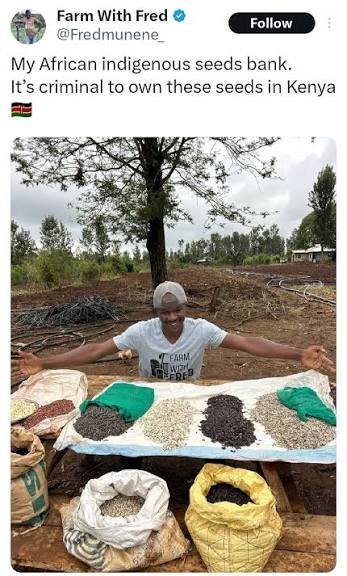
The long awaited day after decades of tension in farming communities is here. As we speak, Kenya awaits a High Court ruling that could redefine who truly owns the country’s seeds and who gets to plant them.
At the centre of the case is the Seeds and Plant Varieties Act (Cap 326), a law that criminalizes the very heart of traditional agriculture. Did you know that legal action can be taken against you as a farmer for simply saving seeds or sharing them? Under the current framework, it is a crime to freely exchange or sell any seed variety that is not officially certified by the government. If you are caught you risk being fined or even imprisonment.
For the 15 smallholder farmers who took the matter to court backed by seed sovereignty organisations across the country, this is a constitutional fight. They argue that the Act violates their fundamental rights to culture and community heritage. And truly, it is a violation of a people’s food and livelihood. To them, indigenous seeds are about inheritance and survival. Simply, this is war on a people.
If the court rules in favour of the farmers
Kenya could see a historic shift. The judgment may:
- Strike down or suspend the clauses that criminalisze seed sharing.
- Force Parliament and the Ministry of Agriculture to rewrite regulations to recognize farmer managed seed systems.
- Open the door for communities to save, exchange and distribute indigenous seeds without fear of arrest.
- Set a precedent for other African countries grappling with similar laws.
I am not sure of this is a first for Africa of if there is any other country that has taken this issue to court. All I know is many other farmers across the continent have been pushing back and fighting against this draconian laws. And if the Kenyan farmers manage to win this case, well, a precedent will have been set.
For millions of smallholder farmers who depend on saved seeds, this would be a major win that will protect biodiversity and restore cultural agricultural practices.
If the court upholds the current law
Farmers may continue facing:
- Legal restrictions on exchanging uncertified seeds.
- Higher dependency on commercial seed companies.
- Rising costs of certified seed, which many rural households cannot afford. (Maybe this was the whole point from the start, for seed companies to maximize on profits?)
If this happens today, civil society groups have already hinted that they are ready to appeal to higher courts and lobby Parliament for amendments.
A possible middle ground ruling
Kenyan courts, notorious for often taking a balanced approach may decide to do the following:
- Ask the government to review the contentious clauses
- Recognise indigenous seed rights but set conditions for commercial sale, or
- Create temporary protections while broader reforms are drafted.
Whatever the outcome, today’s ruling marks the first major constitutional test of how Kenya treats its indigenous plant heritage in the modern and heavily commercialized seed era.
This matters more than we think because seeds are the foundation of food security.
For generations, Kenyan farmers have selected, stored and exchanged seeds adapted to local climates. Seeds like sorghum that survives drought, beans that resist pests and maize that thrives without fertiliser. we saw our grandmothers do it for decades, and then suddenly they could not anymore. Why? Is this not a violation on human rights, for lack of a better term? Restricting these practices threatens both biodiversity and farmer autonomy.
A ruling in favour of the farmers could shift agricultural policy toward a more inclusive model while ruling against them could tighten the grip of the formal seed sector and push traditional varieties further to the margins. At this point, this is the last thing we need as Africans, seeing the rise in lifestyle diseases and everything else going on.
As the country waits…
I can only imagine what’s going on in whatsApp groups of agroecology networks, waiting with bated breath. Will the law finally recognize the farmer as a custodian of seed and not a criminal, as currently is?
The answer will shape not just Kenya’s agriculture but the wider African conversation about sovereignty and the future of food.