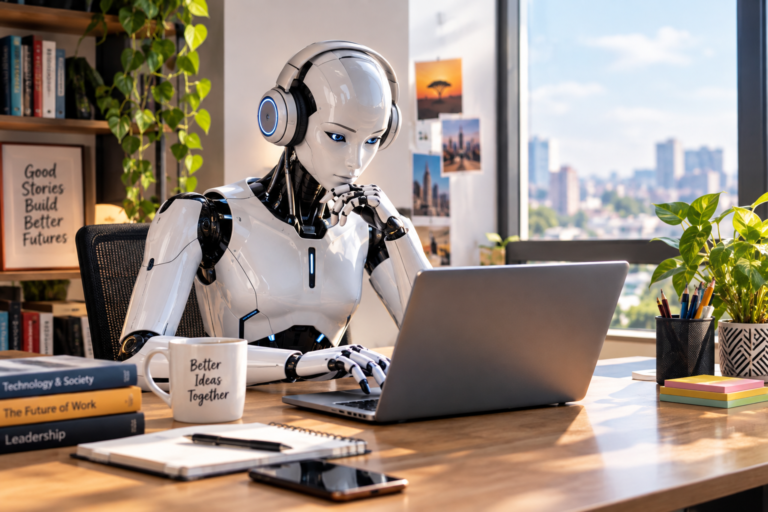
It is the era of artificial intelligence, and Albania recently announced the world’s first AI minister. Diella, for that is her name, is a machine-coded official tasked with cleaning up public procurement. She (I am assuming that is the assigned gender) has been hailed as a symbol of bold innovation. Is this the beginning of a future where algorithms and not politicians, might govern nations? Are all those sci-fi movies we watched in awe and fascination, while assuming them to be things that would happen hundreds of years after we die, finally unfolding right under our noses?
Writing this, I tried to imagine such an experiment taking root in Africa.
Is it really possible? For personal reasons that I feel like sharing, the answer is a big NO.
Africa’s political and cultural realities make it almost impossible for a machine to ascend to leadership. Governance in Africa is all about identity, charisma and human presence. Remember how they kept railing former CJ Maraga, (who has been open about his intention to vie for presidency) about his lack of Charisma until he pulled that joke on us by appearing in a video with singer Charisma? Yes, charisma is kind of a big deal in these parts of the world.
African leaders are big on flamboyancy. An AI minister may crunch numbers, but can it shake hands at funerals and invoke fake ancestral wisdom at rallies? Can it embody the trust people place in a leader they can see and feel?
Also, there is that not so small detail of trust. For a people that already view their leaders with suspicion and zero trust, how will we believe an imaginary being somewhere? Who is to say that this “being” is untouchable? Simply, Who controls the algorithm? Who feeds it information? Who benefits from its decisions? This is Africa, the endless land of possibilities when it comes to corruptible leaders. Nothing is beyond these tumbocrats, not even an invisible leader that lives in the cloud (sic).
On paper an AI minister looks like the perfect incorruptible official, or even the perfect tool for sniffing out corrupt deals. Everytime they talk about this Albania AI minister, they point out that unlike humans, it cannot be bribed with envelopes of cash, practise nepotism or be pressured by political allies.
An incorruptible algorithm overseeing tenders and contracts is the dream of every anti-graft crusader.
It is for this very reason that such technology can never be allowed in Africa. Because in Africa politicians must eat. They must appoint their relatives to the KRA’s of this world and get kickbacks for every single contract they dish out. They use millions (billions even) to bribe their way into office, how the hell do you expect them to recoup their finances back?
Say, through some rare miracle this machine was introduced, who would write its code and train its models? The same elites whose fortunes depend on opaque deals? African leaders would never stand for that, unless of course, they find a way to programme this AI to mask their corruption more elegantly.
And if we are being honest, beyond suspicion lies a harder reality, that of uneven access. While it is true that Internet penetration across Africa is rising, millions still lack reliable connectivity or even electricity. Now think of the rural areas where citizens walk miles to a government office just to get basic services. How then could they access this….this….”robot”? For many, an AI leader is simply another elite experiment built far above the struggles of ordinary people.
We might all marvel at Albania’s AI minister, but the truth is, Africa could never.
I would love to write something as inspirational as “Leadership in Africa demands more than algorithms; it demands a human soul.” But the paradox is, the leaders in Africa do not have a soul.