When the Africa Cup of Nations (AFCON) rolls around, we talk goals, upsets, referees, heartbreaks and glory. We talk drama, because AFCON is never short of those. But beyond the noise of vuvuzelas and VAR debates lies a tournament packed with quietly fascinating history. Here are AFCON facts that even you as a die hard fan might have missed.
1. The First Goal in AFCON History Was Scored in 1957
AFCON began modestly in 1957 with just three teams: Egypt, Sudan, and Ethiopia.
The honour of scoring the very first AFCON goal went to Raafat Attia of Egypt, in a semifinal match against Sudan. By the way, Egypt features prominently in this article and as you read on you will realise it is the most decorated African team when it comes to AFCON, from hosting to scoring to coaches and finally to trophies.
In the first ever AFCON tournament, there were no group stages, no qualifying rounds and no sponsorships, just raw continental ambition and a dream that would become Africa’s biggest football spectacle. Also, South AFrica was invited but the invite later revoked due to it’s Apartheid laws.
2. Egypt Is the Most Successful Team, by Far
Like I already mentioned, no country comes close to Egypt’s dominance at AFCON.
- AFCON titles: 7
- Years won: 1957, 1959, 1986, 1998, 2006, 2008, 2010
- Unmatched feat: Winning three consecutive titles (2006–2010)
Cameroon comes second after Egypt, having won 5 AFCON titles (1984, 1988, 2000, 2002, 2017)
3. Samuel Eto’o Is AFCON’s All Time Top Scorer
While many players shine briefly at AFCON, Samuel Eto’o turned the tournament into his personal stage.
- Total AFCON goals: 18
- Tournaments played: 6
- Titles won: 2 (2000, 2002)
What makes this record special is that it has stood firm despite the rise of prolific modern forwards (think, Salah) Eto’o didn’t just scor. He defined AFCON attacking excellence.
4. The Most Decorated AFCON Coach Isn’t European
That honour belongs to Hassan Shehata of Egypt.
- AFCON titles as coach: 3
- Years: 2006, 2008, 2010
- Record: The only coach to win AFCON three times in a row
In an era before “foreign saviour coaches” became fashionable, Shehata proved that African tacticians could dominate at the highest level.
Other notable coach names include;
- Charles Gyamfi (Ghana): Won AFCON as a player and coach
- Hervé Renard: Won AFCON with two different countries (Zambia 2012, Côte d’Ivoire 2015)
5. Egypt Has Hosted AFCON More Than Any Other Country
- Times hosted: 5 (1959, 1974, 1986, 2006, 2019)
From the early years to the modern era, Egypt has repeatedly stepped in when CAF needed reliable infrastructure, making it AFCON’s most trusted host nation.
6. Zambia’s 2012 Win Happened at a Site of National Tragedy
One of AFCON’s most emotional moments came in 2012, when Zambia won the title in Libreville, Gabon. This mattered because the final was played near the site where Zambia’s national team died in a plane crash in 1993. In that final, Zambia defeated Côte d’Ivoire on penalties as many players dedicated the win to the fallen heroes.
It remains one of the most spiritually powerful victories in AFCON history.
7. AFCON Was Once Played Every Two Years Religiously
Unlike the Euros or Copa América, AFCON traditionally runs on a biennial schedule.
This frequency has often frustrated European clubs, but for African fans, it means more moments of magic as more history is written in quick succession.
8. AFCON Has Crowned First Time Winners More Often Than You Think
AFCON is famously unpredictable. First time winners include:
- Zambia (2012)
- Tunisia (2004)
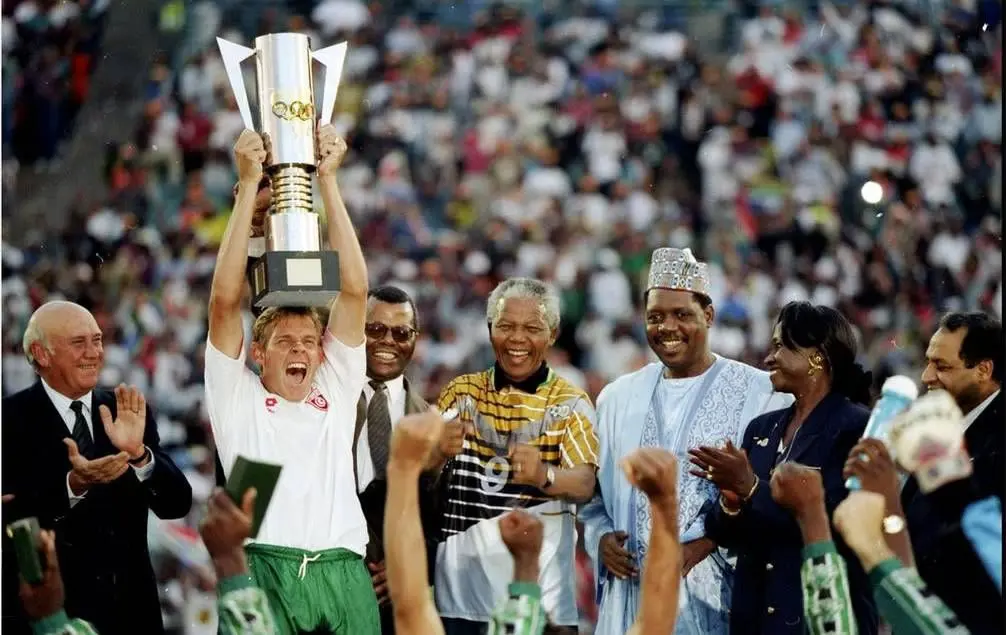
- South Africa (1996)
- Ivory Coast (1992)
Unlike many continental tournaments dominated by one or two giants, AFCON has a long tradition of surprise champions.
9. No AFCON Final Has Ever Ended Goalless After Penalties Were Introduced
AFCON finals are dramatic by nature, but since penalty shootouts became standard, every final has produced a decisive winner, no matter how tense or cagey the match. In AFCON, heartbreak always finds a soundtrack.
10. AFCON Is Older Than the European Championship
AFCON kicked off in 1957.
The UEFA European Championship began in 1960.
Africa’s premier football competition predates one of the world’s most celebrated tournaments yet still fights for the respect it deserves. (Time to blame our politicians, once again.)
AFCON FACTS THEY RARELY TELL YOU
11. Cameroon Is the Most Red-Carded Team in AFCON History
For all their glory, Cameroon also holds a less glamorous distinction. They are widely regarded as the most red carded team in AFCON history.
Their aggressive, physical style especially in the 1990s and early 2000s produced frequent dismissals, tournament suspensions and matches that felt closer to combat than football (lol).
When it comes to rough play (no pun intended) Cameroon is king.
12. Some Players Were BANNED for Using Witchcraft Accusations
AFCON has had its fair share of spiritual drama, and if we are being honest, would it really be an African tournament without witchcraft accusations?
Over the years, players and officials have been fined or warned for accusing opponents of witchcraft and teams have protested matches citing spiritual interference. The result is CAF repeatedly issuing bans on religious or mystical demonstrations on the pitch.
While few cases were publicized globally, CAF quietly tightened regulations after repeated controversies especially in the 80s and 90s. ( I can only imagine how crazy the 80’s were.) AFCON learned early that magic might win folklore, but not trophies.
13. Entire Countries Have Been BANNED from AFCON
Yes, whole nations, not just players, with notable bans including:
- Kenya
- Banned multiple times (notably in the 1980s and 1990s)
- Reasons: government interference in football administration
- Zimbabwe
- Suspended over unpaid dues and administrative chaos
- Chad
- Withdrawn or banned after refusing to honour fixtures
If there is one thing that CAF is ruthless about, it’s politics meddling in football.
14. AFCON Once Expelled a Team Mid Tournament
In AFCON 1996, Nigeria withdrew after qualifying. Why? There were political tensions between Nigeria’s military government and host nation South Africa, safety concerns for players and a diplomatic standoff. CAF’s response? Nigeria was banned from the next two AFCON tournaments, fined heavily and stripped of goodwill it took years to rebuild. A bit over the top reaction, if you ask me.
It was at this moment when it became clear that AFCON does not forgive withdrawals lightly.
15. Some Country Names Are “Unofficially Banned” in Records
You won’t see these names listed cleanly in modern CAF stats:
- Zaire → now DR Congo
- Upper Volta → now Burkina Faso
- Gold Coast → now Ghana
Titles and appearances are retroactively reassigned, meaning casual fans often misread AFCON records while some countries appear to gain trophies overnight.
16. AFCON Had a Trophy You Could Keep If You Won Three Times
Before the current trophy, teams that won AFCON three times could keep the trophy permanently. However, Only Ghana and Egypt ever achieved this. After Egypt’s third permanent claim, CAF said: enough is enough and introduced a trophy that can no longer be retired. (sounds like jealousness lol.)
17. AFCON Once Had Matches Without Goalkeepers
In the early editions, teams sometimes travelled without full squads so injuries and suspensions left sides improvising. This resulted outfield players occasionally finishing matches in goal (I remember seeing such a match once, just don’t remember the exact match, and it wasn’t AFCON either.)
There were no emergency goalkeeper rules so if your keeper was gone, you adapted or you suffered.
18. AFCON Has Recorded One of the Fastest Red Cards in International Football
Several AFCON matches feature red cards within the first 2–3 minutes with Common reasons being reckless tackles, retaliation punches and ofcourse, dissent before settling nerves.
With AFCON, it is war from the word go, and the intensity doesn’t wait for warm ups.
19. Some Coaches Were Fired DURING the Tournament
AFCON chaos does not end on the pitch. Not even the bench is spared in the madness.
There are documented cases where coaches were dismissed mid tournament and their assistants took over instantly. Some of these include; Patrice Neveu – DR Congo (AFCON 2019), Jean Thissen – Cameroon (AFCON 1996), Evariste Ndayishimiye (Caretaker changes) – Burundi (AFCON 2019) , Hossam El-Badry – Egypt (AFCON 2019, post-match dismissal after Egypt’s Round of 16 elimination (while the tournament was still ongoing) and Christian Gourcuff – Algeria (AFCON 2017). Gourcuff announced resignation during the tournament after group stage failure even though it was widely understood as a forced exit, especially sicnce Algeria were among the favourites and crashed out early.
Others include Milovan Rajevac – Ghana (AFCON 2010), who was removed during the tournament after internal disagreements. Ghana still finished runners up, proving AFCON’s unique chaos factor.
20. AFCON Once Had No Qualification, You Just Showed Up
Early AFCON editions had no qualifiers, with teams being invited or self selected. Some even withdrew days before kickoff. Clearly, this tournament has been through a lot, surviving cancellations, walkovers and logistical nightmares before becoming today’s polished event.
21. AFCON Is the Only Major Tournament Where Defending Champions Routinely Crash Out Early
Statistically, defending champions are more likely to be eliminated in the group stage at AFCON than in the Euros or Copa América. Reasons often cited include fatigue from club football, tactical predictability and psychological pressure. AFCON does not reward nostalgia.
22. AFCON Once Changed Hosts Less Than a Year Before Kickoff
On multiple occasions host nations pulled out late as CAF scrambled to relocate. Replacement hosts stepped in under pressure
AFCON is the tournament that refuses to die, even when plans collapse.
23. AFCON Has More Political Boycotts Than Any Other Continental Tournament
This is after all, Africa, with Boycotts happening due to a number of issues, notably:
- apartheid era politics
- civil wars
- diplomatic tensions
- regime changes
If you look at AFCON history carefully, you might catch a glimse of a timeline of Africa’s political struggles.
24. A Goalkeeper Has Scored at AFCON
Zambia’s Kennedy Mweene, one of Africa’s most famous goalkeeping figures, is among the rare goalkeepers to have scored in AFCON competition, converting a penalty – an extraordinary moment in tournament history.
25. Winning AFCON Still Doesn’t Guarantee Global Respect
Despite its age, scale and talent, AFCON winners often fight for recognition on the global stage, making every victory a statement, not just a trophy.
AFCON is not chaotic because Africa is chaotic.
It is chaotic because Africa is alive in every aspect be it politically, culturally or emotionally. Africans are a a passionate people, and every red card, ban or boycott tells a story bigger than football.